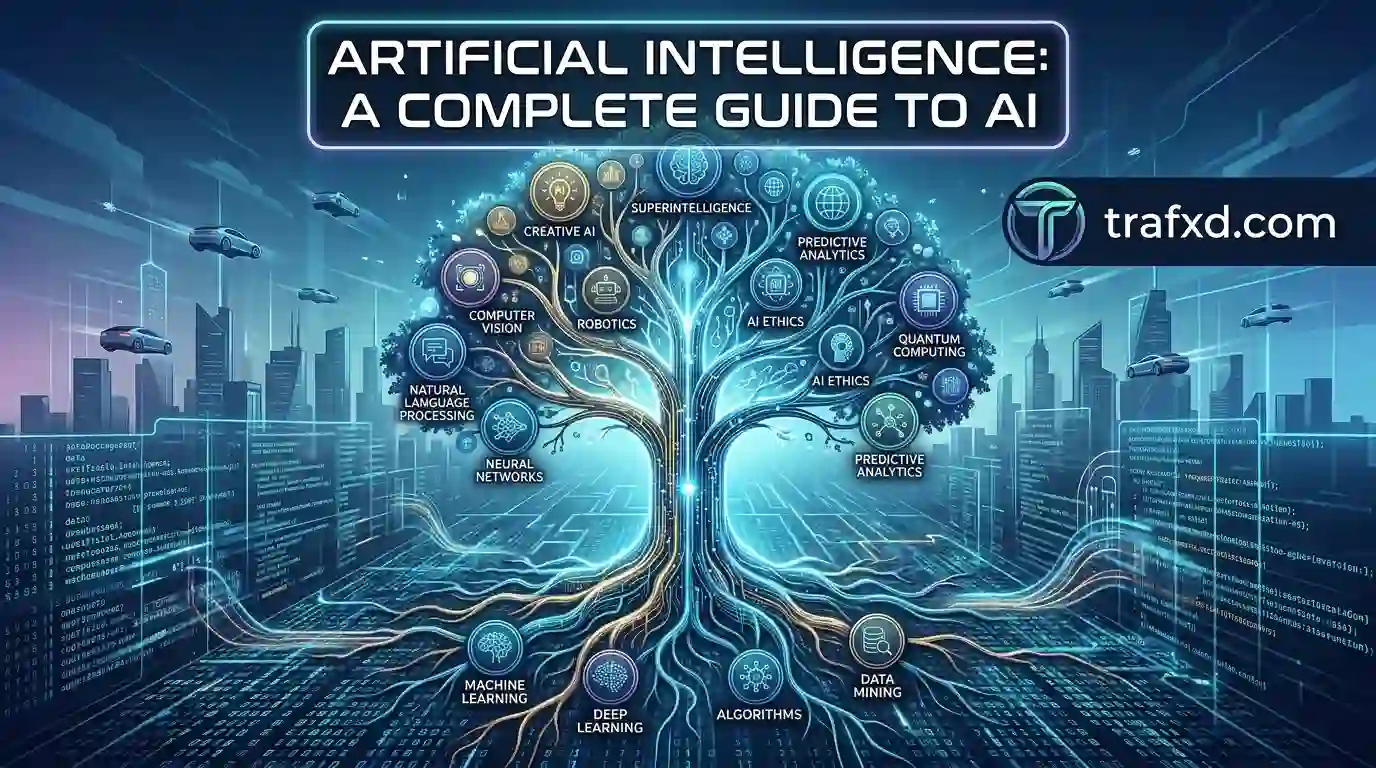
Artificial Intelligence: A Complete Guide To AI
Think about a normal day. You wake up and check your phone. It recognizes your face, suggests words while you type a message, recommends a video, filters unwanted emails, and perhaps even reminds you about an appointment. Later, you open a navigation app to find the quickest route, order something online, or ask a virtual assistant a question.
You may not think about these activities as examples of artificial intelligence, but AI is often working quietly behind them.
Artificial intelligence has moved far beyond the idea of futuristic robots. Today, it is built into many of the digital products and services people use every day. It can recognize patterns, understand speech, make predictions, personalize recommendations, and automate repetitive tasks.
The interesting part is that much of this technology works in the background. You may use AI several times a day without consciously realizing it.
In this guide, we will explore the role of artificial intelligence in daily life, from smartphones and social media to education, healthcare, shopping, entertainment, transportation, and smart homes. We will also look at the benefits, risks, and ways AI tools may influence our everyday routines in the future.
What Is Artificial Intelligence?
Artificial intelligence is a branch of technology that allows computer systems to perform tasks that normally require some form of human intelligence.
These tasks can include recognizing images, understanding language, identifying patterns, making predictions, and generating content.
You don’t need to understand complicated mathematics to understand the basic idea.
Imagine an app that learns which type of music you usually enjoy. After looking at your listening behavior, it may recommend similar songs. Or consider a navigation app that studies traffic information and suggests another route when your usual road becomes busy.
In both cases, the system is using information and patterns to make a useful prediction or decision.
How Does Artificial Intelligence Work?
AI systems can work in different ways, depending on their purpose. Many modern systems use machine learning, where algorithms learn patterns from data.
A simplified process looks like this:
- Data is collected — such as text, images, voice, location, or user activity.
- The system analyzes patterns in that information.
- The AI produces a prediction or result.
- Feedback and additional data can help improve future performance.
For example, when a shopping website recommends a product, it may consider products you viewed, previous purchases, searches, and other relevant patterns.
The technology is much more complicated behind the scenes, but the basic idea is simple: AI uses data and patterns to perform tasks or make predictions.
The Role of Artificial Intelligence in Daily Life
One reason AI has become so important is that it doesn’t always announce itself.
You may see a chatbot and immediately recognize it as AI. However, AI can also be hidden inside a camera app, email service, navigation system, bank application, or streaming platform.
Common examples include facial recognition, recommendation systems, spam filters, voice assistants, traffic prediction, fraud detection, and smart-home automation.
Let’s look at some of the ways this technology is becoming part of ordinary routines.
AI in Smartphones and Mobile Apps
For many people, the smartphone is one of the easiest places to notice artificial intelligence in everyday life.
Modern phones contain features that can recognize images, process speech, predict text, improve photographs, and personalize certain experiences.
Face Recognition and Phone Security
When you unlock your phone using facial recognition, the device analyzes specific characteristics of your face to determine whether you are an authorized user.
This makes unlocking quicker while adding another layer of security.
Fingerprint recognition works in a similar way by identifying patterns associated with your fingerprint.
Smart Cameras and Photos
Have you ever taken a photograph in poor lighting and noticed that your phone automatically improves it?
AI-powered image processing can help smartphones adjust photographs, recognize scenes, organize images, and apply certain effects.
Your phone may also recognize people, places, or objects in photographs, making it easier to find a particular picture later.
Voice Assistants and Predictive Text
Voice assistants can understand spoken requests and respond with information or actions.
Predictive text is another simple example. As you type, your keyboard may suggest the next word or correct a spelling mistake.
These small features save seconds at a time, but those seconds add up when you use your phone throughout the day.
AI in Communication and Social Media
Artificial intelligence also influences how we communicate online.
When you receive an email, send a message, or scroll through a social media platform, AI may be helping organize the information you see.
Smart Email and Spam Filters
Nobody wants an inbox filled with unwanted messages.
Email services use automated systems to identify suspicious or unwanted messages and move many of them away from the main inbox.
This helps users spend less time sorting through irrelevant emails.
Personalized Social Media Feeds
Open a social media app, and you probably won’t see posts in a completely random order.
Recommendation and ranking systems can analyze different signals to decide which content may be relevant or interesting to you.
Your previous interactions, viewing behavior, and engagement can influence what appears in your feed.
This personalization can make social media more useful, but it also means that the content you see may be shaped by algorithms.
AI Chatbots and Customer Support
Have you ever visited a website and received an instant answer from a chatbot?
Businesses increasingly use AI-powered assistants to answer common questions, guide customers, and provide support outside normal working hours.
A chatbot can be useful for simple requests, although more complicated problems may still require a human representative.
AI in Online Shopping
Online shopping has changed dramatically over the past decade, and AI is one reason websites can provide increasingly personalized experiences.
Personalized Product Recommendations
Suppose you search for running shoes. Later, you may notice recommendations for sports clothing, socks, or similar footwear.
Recommendation systems can use browsing behavior, previous purchases, searches, and other information to predict products that may interest you.
This benefits shoppers by helping them discover relevant products without searching through thousands of options.
It also helps businesses understand customer preferences.
AI-Powered Search
Online stores can use AI to understand what shoppers mean rather than relying only on exact words.
For example, someone might search for “comfortable shoes for walking,” rather than typing the exact name of a particular product.
A smarter search system can connect that request with relevant products.
Fraud Detection
AI can also be used behind the scenes to identify unusual payment behavior.
If a transaction looks very different from normal activity, a financial service may flag it for additional verification.
This doesn’t mean every unusual transaction is fraudulent. Instead, automated systems can help identify patterns that deserve attention.
AI in Entertainment
What should you watch tonight?
What song should you listen to?
These decisions may seem simple, but recommendation systems often help answer them.
Movies and Video Recommendations
Streaming platforms can study viewing behavior and recommend movies or shows that might match your interests.
If you regularly watch documentaries, for example, the platform may suggest more documentaries.
The goal is to reduce the amount of time you spend searching for something to watch.
Music and Podcast Recommendations
Music applications use similar ideas.
Your listening history, favorite artists, skipped songs, and playlists can help a recommendation system predict what you might enjoy next.
That is why your music app can sometimes introduce you to a song you end up loving.
AI-Generated Content
Generative AI has added another dimension to entertainment.
People can now use AI tools to create images, write stories, generate ideas, produce music, and experiment with video.
This doesn’t mean every piece of digital entertainment is AI-generated. Instead, AI is becoming another creative tool that people can use alongside traditional methods.
AI in Education and Learning
Education is another area where AI can make everyday tasks easier.
Students can use AI-powered tools for language practice, writing feedback, explanations, research assistance, and personalized learning.
Personalized Learning
Not every student learns at the same speed.
Some learners understand a concept immediately, while others need more examples and practice.
AI-based educational platforms can adapt exercises and recommendations according to a learner’s performance.
For example, if a student repeatedly struggles with a particular type of mathematics question, an adaptive learning system may provide additional practice.
AI Tutors and Learning Assistants
AI assistants can explain difficult concepts in simpler language, generate practice questions, or help students review a topic.
However, there is an important difference between using AI to learn and using AI to avoid learning.
Asking an AI system to explain why an answer is wrong can improve understanding. Asking it to complete every assignment without learning the material defeats the purpose of education.
Language and Writing Tools
Students and professionals can also use AI-powered writing and translation tools.
These systems may help identify grammar problems, suggest clearer wording, translate text, or provide ideas.
The best approach is to use these tools as assistants while keeping your own judgment and understanding involved.
AI in Healthcare and Fitness
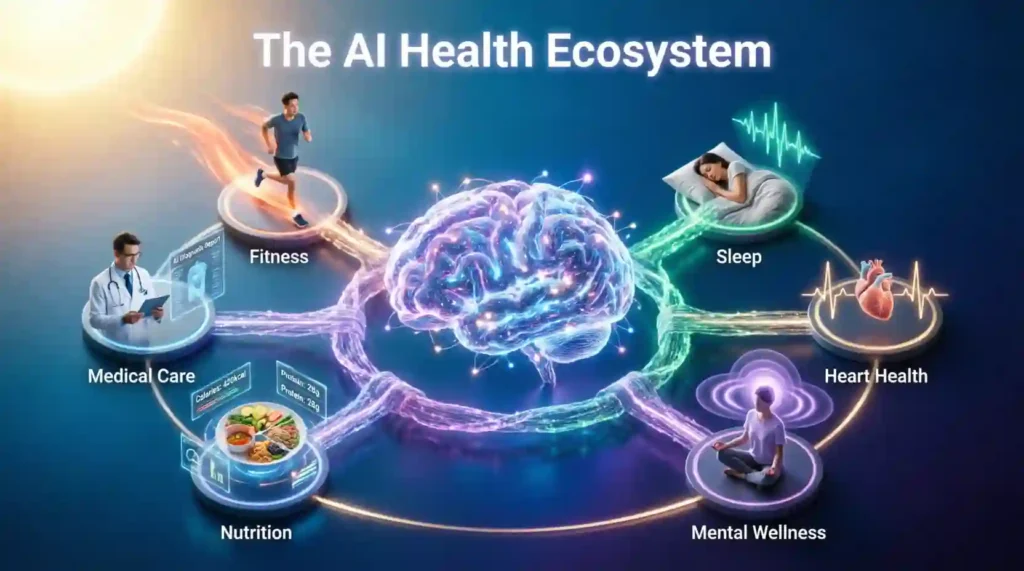
Healthcare is one of the most important areas where artificial intelligence is being developed and used.
AI can help professionals analyze information, identify patterns, support medical imaging, automate administrative work, and monitor certain health-related data. However, medical decisions should still involve qualified healthcare professionals.
AI for Health Monitoring
Fitness watches and other wearable devices can collect information about activities such as movement, exercise, sleep, and heart rate.
Algorithms can analyze this information and present trends or suggestions to users.
For example, a fitness application might notice changes in your activity levels and encourage you to move more.
Medical Data and Diagnosis Support
Healthcare professionals may use AI systems to analyze medical images or other information and identify patterns that deserve closer attention.
The purpose is often to support professionals rather than replace them.
This distinction is important because healthcare decisions can have serious consequences, and AI systems can make mistakes.
AI in Fitness Apps
AI-powered fitness applications can provide personalized workout suggestions, track progress, and identify patterns in exercise behavior.
For someone trying to build a consistent routine, these features can make technology feel like a personal assistant.
AI in Transportation and Navigation
Getting from one place to another has also become easier with AI-powered technology.
AI-Powered Navigation Apps
Navigation applications can analyze traffic conditions, road information, and other data to estimate travel times and suggest routes.
If your usual road becomes congested, the application may recommend an alternative.
This is a great example of AI providing value without requiring the user to understand how the system works.
AI in Cars
Modern vehicles can include features such as parking assistance, lane warnings, driver monitoring, and other forms of automated assistance.
These systems can use cameras, sensors, and software to recognize what is happening around the vehicle.
The technology can make driving more convenient, but drivers still need to remain attentive and follow safety requirements.
Ride-Hailing and Travel
Ride-hailing platforms can also use algorithms to match riders and drivers, estimate arrival times, optimize routes, and respond to changing demand.
The result is a smoother experience for both passengers and drivers.
AI in Smart Homes
The idea of a “smart home” once sounded futuristic. Today, many households use connected devices that can automate everyday tasks.
Smart Speakers and Voice Assistants
A smart speaker can respond to voice commands, set reminders, answer questions, play music, or control compatible devices.
Instead of opening an application and searching through menus, you can simply speak a command.
Smart Security Systems
Smart cameras and security devices can detect movement and, depending on the system, identify certain patterns or objects.
These features can help homeowners monitor their properties more conveniently.
Smart Appliances
Some modern appliances can automate tasks based on schedules, settings, or usage patterns.
Robot vacuum cleaners are a simple example. They can map or navigate spaces and perform cleaning with limited human input.
Benefits of Artificial Intelligence in Daily Life
The growing use of AI brings several practical advantages.
1. Saves Time
AI can automate repetitive tasks and reduce the amount of manual work people need to do.
2. Provides Personalized Experiences
Recommendation systems can adapt content, products, music, and other services to individual preferences.
3. Makes Digital Services More Convenient
Voice commands, automated suggestions, smart search, and chatbots can make everyday digital interactions faster.
4. Supports Better Decisions
AI can process large amounts of information and identify patterns that might otherwise be difficult to notice.
5. Improves Accessibility
Speech recognition, captions, translation, and other AI-powered features can make technology easier to use for people with different needs.
The biggest advantage isn’t necessarily that AI makes everything “automatic.” Its real value often comes from helping people spend less time on routine tasks and more time on things that require human judgment and creativity.
Challenges and Risks of Using AI Every Day
AI is useful, but it isn’t perfect.
As people rely more heavily on intelligent systems, several concerns deserve attention.
Privacy and Personal Data
Many digital services collect information about how people use their products.
This can include searches, locations, preferences, purchases, and interactions.
Users should understand what information an application collects and how that information is used.
AI Mistakes and Incorrect Information
An AI system can produce an answer that sounds confident but is still incorrect.
This is especially important when dealing with education, finance, healthcare, or other sensitive subjects.
Always verify important information instead of assuming that an AI-generated answer must be correct.
Overdependence on Technology
Technology should make life easier, not eliminate our ability to think for ourselves.
If people depend on AI for every decision, they may gradually lose confidence in their own problem-solving skills.
Bias and Fairness
AI systems learn from data, and data can contain limitations or biases.
As a result, an AI system may sometimes produce unfair or inaccurate results.
Developers and organizations need to test these systems carefully and maintain appropriate human oversight.
How AI May Change Daily Life in the Future
The role of artificial intelligence in daily life is likely to grow as technology becomes more capable.
We may see more personalized digital assistants that can help organize schedules, summarize information, manage routine tasks, and interact with different applications.
Smart homes may also become more connected. Instead of simply responding to individual commands, devices could coordinate tasks around a person’s routines.
Education may become increasingly personalized, with learning platforms adapting lessons to individual strengths and weaknesses.
At the same time, human involvement will remain important.
The most useful future may not be one where AI replaces people. It may be one where humans and AI work together, with technology handling repetitive tasks while people focus on creativity, relationships, judgment, and complex decisions.
Conclusion: The Growing Role of AI in Everyday Life
Artificial intelligence is no longer something that belongs only in research laboratories or science-fiction movies. It is already part of ordinary routines.
From unlocking a smartphone in the morning to finding a route, watching a recommended video, shopping online, studying a new subject, or using a smart device at home, AI can influence many small decisions throughout the day.
The role of artificial intelligence in daily life is therefore less about futuristic robots and more about the technology quietly working behind familiar products and services.
AI offers real benefits, including convenience, personalization, automation, and faster access to information. But it also brings challenges involving privacy, accuracy, bias, and overdependence.
The smartest approach is not to accept or reject AI completely. Instead, learn how it works, understand its limitations, and use it as a helpful tool while keeping human judgment at the center.
Frequently Asked Questions(FAQs)
What is an example of AI in everyday life?
Smartphone face recognition, personalized video recommendations, navigation apps, spam filters, voice assistants, online shopping recommendations, and fraud detection are common examples of AI being used in everyday activities.
How does AI make daily tasks easier?
AI can automate repetitive work, provide recommendations, recognize patterns, understand voice commands, and personalize digital services. This can save time and make many everyday activities more convenient.
Do smartphones use artificial intelligence?
Yes. Many smartphones use AI or machine-learning technologies for features such as facial recognition, voice processing, predictive text, image enhancement, photo organization, and personalized suggestions.
Is AI safe to use every day?
AI can be useful and safe when used appropriately, but users should still consider privacy, security, accuracy, and the limitations of AI systems. Important decisions should not be based solely on an AI-generated answer.
How does AI affect students?
AI can help students understand difficult topics, practice languages, receive writing feedback, generate study questions, and organize information. However, students should use it to support learning rather than replace their own work and understanding.
Can AI replace humans in everyday activities?
AI can automate many repetitive tasks, but it does not completely replace human judgment, creativity, empathy, and responsibility. In many situations, the best results come from people using AI as a tool rather than handing over complete control.
What are the disadvantages of using AI in daily life?
Potential disadvantages include privacy concerns, inaccurate information, overdependence on technology, biased results, and reduced human involvement in certain tasks. Responsible use and human oversight can help reduce these risks.