Complete Guide to Digital Marketing, Technology & AI
Digital growth has become one of the most important goals for modern businesses. Whether you run a small local business, an online store, a startup, or an established company, having a strong online presence can help you reach more people, build trust, and generate consistent growth. However, digital growth is not simply about creating a website or posting regularly on social media. It involves combining marketing, technology, data, and customer experience into one connected strategy. Understanding the AI role in digital marketing is also becoming important, as artificial intelligence can help businesses analyze data, personalize customer experiences, automate tasks, and improve marketing decisions.
At the center of this process is digital marketing. Search engine optimization (SEO), content marketing, social media, email campaigns, paid advertising, and affiliate marketing can help businesses attract potential customers and turn them into loyal buyers. Each channel has a different purpose, but they work best when they support the same overall business goals.
In this guide, we will explore the key areas that drive digital growth, including digital marketing, SEO, technology, artificial intelligence, content, social media, automation, and other important digital strategies. Whether you are a beginner or already have experience with online marketing, understanding how these areas work together can help you build a stronger and more effective digital presence.
What Is Digital Growth and Why Does It Matter?
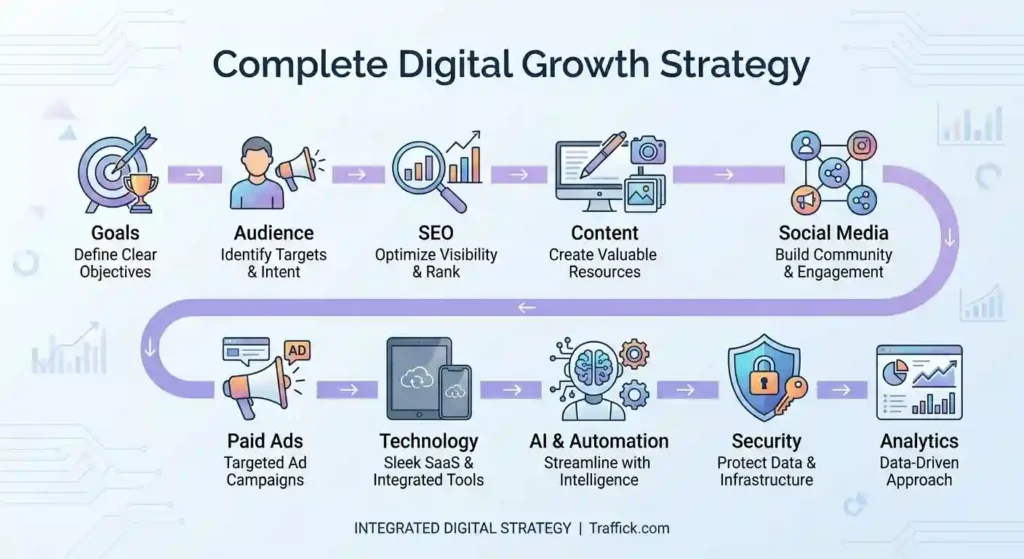
Digital growth means using online channels, technology, data, and digital tools to increase a business’s visibility, customers, revenue, and long-term value. It is broader than simply getting more website visitors. A business can experience digital growth by attracting new customers, improving conversion rates, increasing online engagement, building brand awareness, reducing operating costs, or enhancing the customer experience.
For example, an online store might use SEO to attract people searching for its products. It could then use helpful content to answer customer questions, social media to build a community, and email marketing to encourage previous visitors to return. Analytics can help the business understand which channels generate the best results.
How do Marketing and Technology Work Together?
Marketing and technology are closely connected. Marketing focuses on reaching and understanding customers, while technology provides the tools businesses use to do this more efficiently.
A website provides a digital home for a business. Analytics platforms help measure visitor behavior. Automation software can handle repetitive marketing tasks, while customer relationship management systems can organize customer information. AI tools can also help businesses analyze data, generate ideas, personalize experiences, and improve productivity.
When these technologies work alongside marketing activities, businesses can create a more connected customer journey.
The Role of SEO, Content, Social Media, Paid Advertising, and Technology
Several channels contribute to digital growth:
- SEO helps websites appear in organic search results and attract people who are actively looking for information, products, or services.
- Content marketing provides useful articles, guides, videos, and other resources that educate audiences and establish authority.
- Social media marketing helps businesses communicate with audiences, increase awareness, and build relationships.
- Paid advertising allows businesses to reach specific audiences quickly through platforms such as search engines and social networks.
- Technology: Supports analytics, automation, customer management, personalization, and business operations.
The strongest strategies do not treat these channels as separate activities. Instead, they connect them around common business objectives.
Building a Sustainable Digital Strategy
A sustainable digital strategy begins with clear goals. A business should know whether it wants to increase organic traffic, generate leads, improve sales, grow its audience, or strengthen brand recognition.
Next, it needs to understand its audience. Knowing what customers need, what problems they face, and how they search for solutions makes it easier to create relevant marketing campaigns.
Businesses should also measure performance regularly. Metrics such as organic traffic, conversions, engagement, click-through rates, and return on advertising spend can reveal what works and what needs improvement.
Most importantly, digital growth requires consistency. Search algorithms, social platforms, customer expectations, and technology continue to change. Businesses that continually test, learn, improve, and adapt are more likely to build lasting online success.
Digital Marketing to Boost Online Growth
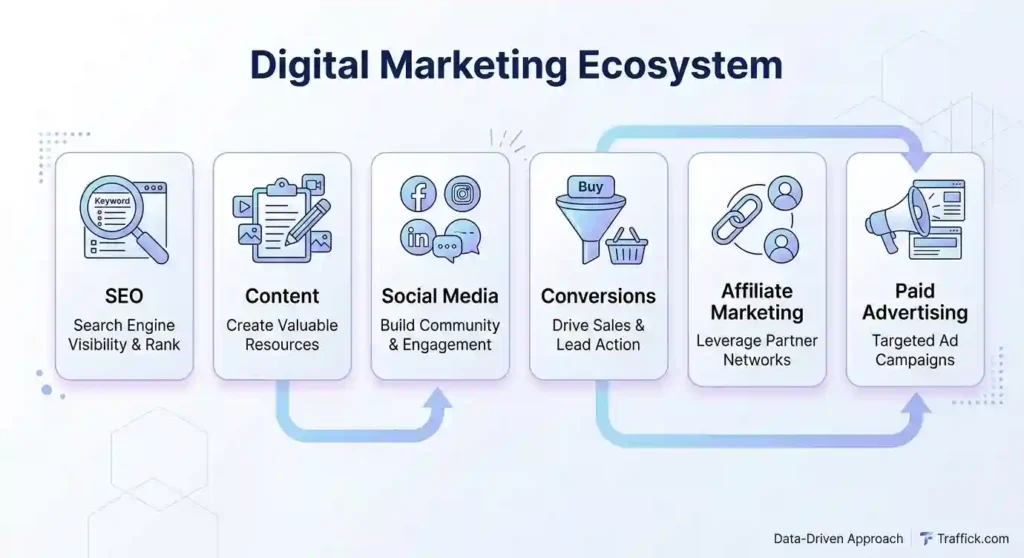
Digital marketing is one of the most important parts of a modern growth strategy. It allows businesses to connect with potential customers through websites, search engines, social networks, email, advertising platforms, and other online channels.
Unlike traditional marketing, digital marketing provides businesses with detailed information about audience behavior. You can see how people discover your website, which content they interact with, where they leave, and which campaigns generate conversions. This data enables better marketing decisions over time.
Digital marketing also allows businesses of different sizes to compete online. A small business does not necessarily need a huge advertising budget to build an audience. By creating useful content, optimizing its website, engaging with customers, and targeting the right audience, it can gradually establish a strong online presence.
What Is Digital Marketing?
Digital marketing refers to promoting products, services, brands, or businesses through digital channels. The digital marketing channels include search engines, websites, social media platforms, email, online advertisements, mobile applications, and other internet-based platforms.
The purpose is not simply to promote something online. Effective digital marketing focuses on reaching the right audience at the right stage of the customer journey.
For example, someone who searches for “best running shoes for beginners” may still be researching. A useful guide can help that person understand the available options. Later, the same person may search for a specific product and become ready to purchase.
This is why digital marketing often works as a journey:
Awareness → Interest → Consideration → Conversion → Retention
Different marketing channels can support different stages of this journey.
SEO and content can attract people during the research stage. Social media can build awareness and engagement. Paid advertising can target people with specific interests or purchase intent. Email marketing can help retain existing customers.
The Main Components of Digital Marketing
Digital marketing contains several major areas. Each one has a different role, but combining them can create a stronger overall strategy.
Search Engine Optimization (SEO)
SEO involves improving a website so it appears more prominently in organic search results.
SEO can help businesses reach people who are already searching for relevant information, products, or services. It includes areas such as keyword research, on-page optimization, technical SEO, internal linking, content quality, website performance, and backlinks.
For example, a bakery could create a page targeting searches related to birthday cakes in its local area. A software company might publish an in-depth guide answering questions about a particular business problem.
SEO usually takes time, but successful optimization can produce consistent organic traffic without paying for every individual click.
Social Media Marketing (SMM)
Social media marketing uses platforms such as Facebook, Instagram, LinkedIn, TikTok, and other networks to connect with audiences.
Businesses can use social media to share educational content, product updates, behind-the-scenes material, customer stories, videos, and promotional campaigns. The best approach depends on the target audience and the nature of the business.
Social media is particularly useful for building relationships. Instead of communicating only when a customer is ready to buy, brands can remain visible and provide value throughout the customer journey.
However, businesses should avoid trying to maintain an active presence on every platform. Choosing the platforms where the target audience is most active is usually more effective.
Content Marketing
Content marketing focuses on creating and distributing useful information for a specific audience.
Common examples include blog posts, tutorials, case studies, videos, infographics, ebooks, podcasts, and guides.
Good content should solve problems rather than simply promote a product. When businesses consistently answer customer questions, they can build credibility and attract visitors through search engines and social platforms.
Content also supports other digital marketing activities. A well-written blog post can generate organic search traffic, provide material for social media posts, support an email campaign, and help potential customers make purchasing decisions.
Paid Advertising
Paid advertising allows businesses to pay for visibility on search engines, social media platforms, websites, and other digital channels.
Search advertising can help businesses appear when users search for specific terms. Social advertising can target audiences based on factors such as interests, demographics, behaviors, or previous interactions.
One advantage of paid advertising is speed. While SEO and organic content can take time to build momentum, an effective paid campaign can begin generating traffic almost immediately.
However, paid advertising requires careful planning. Businesses need to understand their target audience, create compelling advertisements, select appropriate keywords or targeting options, monitor costs, and measure conversions.
Affiliate Marketing
Affiliate marketing is a performance-based model in which businesses reward affiliates for generating sales, leads, or other desired actions.
An affiliate may promote a company’s product through a blog, website, YouTube channel, newsletter, or social media account. When someone completes a qualifying action through the affiliate’s tracking link, the affiliate can receive a commission.
This approach can benefit both sides. Businesses can reach new audiences without relying entirely on their own marketing channels, while affiliates can monetize content and recommendations.
Successful affiliate marketing depends heavily on trust. Audiences are more likely to respond to recommendations that are relevant, transparent, and genuinely useful.
How These Channels Work Together
The real strength of digital marketing appears when these channels support one another.
Imagine a software company publishing an SEO-focused article that answers a common customer question. Search engines bring organic visitors to the article. The company then shares the article on social media and uses it in an email newsletter. A paid campaign may promote the content to a highly relevant audience.
Interested visitors can visit a product page, sign up for a free trial, or join the company’s email list. Analytics then shows which channels contributed to the final conversion.
This creates a connected marketing system rather than a collection of unrelated campaigns.
For this reason, businesses should not ask which digital marketing channel is the “best.” The better question is which combination of channels supports their specific goals, audience, resources, and customer journey.
As digital marketing continues to evolve, businesses will also need to understand emerging technologies such as artificial intelligence, automation, advanced analytics, and other digital tools. These technologies can make marketing more efficient while providing new ways to understand and serve customers.
AI Role in Digital Marketing: How Artificial Intelligence Is Changing Online Growth
Artificial intelligence is changing the way businesses plan, execute, and improve their digital marketing strategies. The AI role in digital marketing goes beyond generating content. Businesses can use AI to understand customers, analyze large amounts of data, automate repetitive tasks, and create more personalized marketing experiences.
How AI Helps Digital Marketing
- Content Creation: AI can help marketers generate ideas, outlines, headlines, product descriptions, and other content faster.
- Customer Personalization: AI can analyze customer behavior and help businesses deliver more relevant content, offers, and recommendations.
- SEO Optimization: AI tools can support keyword research, content analysis, search intent research, and identifying opportunities to improve website visibility.
- Data Analysis: AI can process large amounts of marketing data and identify patterns that may help businesses make better decisions.
- Chatbots and Customer Support: AI-powered chatbots can answer common questions, provide instant assistance, and improve the customer experience.
- Social Media Marketing: AI can help identify content ideas, analyze audience engagement, and support social media planning.
- Email Marketing: AI can help marketers personalize email content, segment audiences, and determine better times to reach customers.
- Advertising Optimization: AI can analyze campaign performance and help marketers improve targeting, bidding, and ad performance.
- Marketing Automation: AI can automate repetitive activities, allowing marketers to spend more time on strategy and creative work.
Why AI Matters for Digital Growth
AI does not replace the need for human creativity and strategy. Instead, it gives marketers powerful tools to work more efficiently and understand their audiences better. When combined with human experience, AI can help businesses create smarter campaigns, improve customer engagement, and build a stronger online presence.
SEO: How Search Engines Drive Organic Traffic
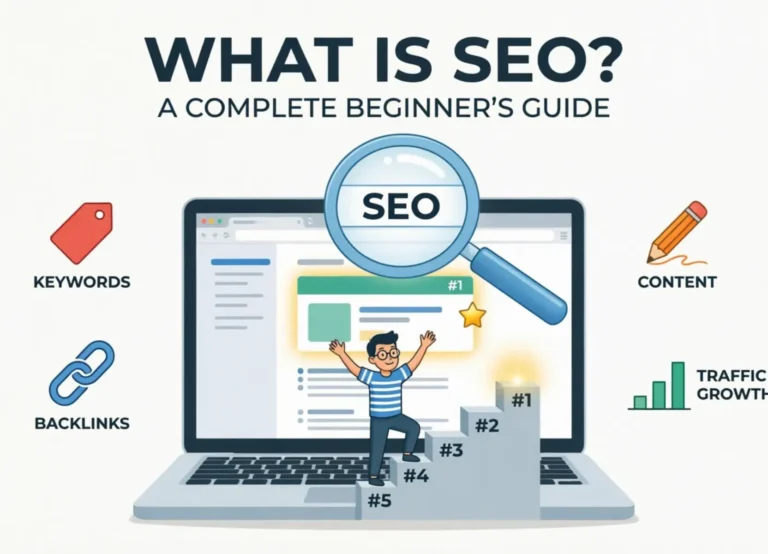
Search engine optimization, or SEO, is one of the most powerful ways to attract organic traffic to a website. Instead of paying for every visitor, businesses can optimize their websites and content to appear in relevant search results. When a page provides useful information and matches what people are searching for, it has a better chance of gaining visibility and attracting qualified visitors.
SEO is not a single technique. It combines keyword research, content optimization, technical improvements, user experience, link building, and an understanding of search intent. A successful SEO strategy focuses on both search engines and real users.
What Is SEO?
SEO is the process of improving a website and its content so search engines can understand, evaluate, and display its pages for relevant searches.
For example, imagine someone searches for “best accounting software for small businesses.” A software company that has created a detailed, useful guide around that topic may have an opportunity to appear in the search results.
SEO can help businesses attract visitors who are already interested in their products, services, or information. This makes organic search particularly valuable for long-term digital growth.
How Do Search Engines Work?
Search engines discover and organize billions of web pages to provide useful results when someone performs a search.
The process generally involves three important stages: crawling, indexing, and ranking.
During crawling, search engine bots discover pages and follow links to find additional content. The information they find can then be stored in the search engine’s index. When someone performs a search, the search engine evaluates relevant pages and determines which results should appear based on many signals.
This means your website needs more than good keywords. Search engines also need to access your pages, understand their content, and determine whether they provide value to users.
Keyword Research
Keyword research helps you discover the words and phrases people use when searching for information online.
A good keyword strategy goes beyond choosing keywords with high search volume. You should also consider competition, relevance, search intent, and how closely a keyword matches your audience’s needs.
For example, “digital marketing” is a broad keyword. A phrase such as “digital marketing strategy for small businesses” is more specific and may attract visitors with a clearer purpose.
Long-tail keywords can be especially useful for newer websites because they often target more specific searches.
On-Page SEO
On-page SEO focuses on elements that you can optimize directly on your website.
These elements can include page titles, headings, URLs, meta descriptions, internal links, images, content structure, and keyword usage.
The goal is not to repeat a keyword. Instead, use relevant terms naturally while creating content that clearly answers the user’s question.
A well-structured page should also be easy to scan. Clear headings, short paragraphs, descriptive subheadings, relevant images, and logical internal links can improve the overall experience.
Technical SEO
Technical SEO focuses on the technical aspects that affect how search engines access, understand, and index a website.
Important areas include website speed, mobile usability, crawlability, indexing, XML sitemaps, robots.txt, canonical URLs, redirects, HTTPS, and structured data.
For example, if important pages are accidentally blocked from crawling, search engines may struggle to discover or index them. Similarly, a slow or difficult-to-use website can create a poor experience for visitors.
Technical SEO does not replace high-quality content. Instead, it provides a strong technical foundation that allows valuable content to perform more effectively.
Off-Page SEO
Off-page SEO refers to activities and signals that occur outside your own website and can influence its authority, reputation, and visibility.
One of the best-known areas of off-page SEO is link building. However, off-page SEO can also involve brand mentions, digital PR, partnerships, reviews, and other activities that help establish credibility.
The focus should always be on earning genuine recognition rather than manipulating search rankings.
Link Building
Links from other websites can help search engines discover pages and can also act as signals of credibility and relevance.
However, not every backlink has the same value. A relevant link from a trustworthy website can be more useful than many unrelated or low-quality links.
Effective link-building strategies can include creating valuable resources, publishing original research, digital PR, guest contributions where appropriate, and building relationships within your industry.
The best approach is to create content that other websites have a genuine reason to reference.
Search Intent
Search intent describes the reason behind a user’s search.
Someone searching for “what is SEO” probably wants to learn. Someone searching for “best SEO tools” may be comparing options, while a person searching for a specific SEO platform may already be ready to take action.
Understanding this difference helps you create content that matches what users actually want.
Common search-intent categories include informational, commercial investigation, transactional, and navigational searches.
Before creating a page, ask a simple question: What does the person behind this search actually want to find?
Content Optimization
Content optimization involves improving existing or new content so that it provides greater value to users and is easier for search engines to understand.
Start by answering the main question clearly. Then organize supporting information logically and cover important subtopics without adding unnecessary filler. Use relevant keywords naturally in appropriate locations, including the title, headings, body text, and other relevant page elements. Add internal links where they genuinely help readers discover related information.
You should also update older content when information becomes outdated. Regular content audits can help identify pages that need new examples, statistics, sections, links, or improved explanations.
The goal is not simply to make content longer. Better content is content that more effectively satisfies the user’s needs.
Measuring SEO Performance
SEO requires ongoing measurement because rankings and traffic can change over time.
Important performance indicators can include:
- Organic traffic
- Search impressions
- Click-through rate
- Keyword rankings
- Organic conversions
- Leads or sales
- Indexed pages
- Backlink growth
- Engagement and user behavior
Tools such as Google Search Console and Google Analytics can provide useful information about how visitors discover and interact with your website.
However, traffic alone does not always indicate success. A page that receives thousands of visitors may generate fewer leads than a highly targeted page that receives only a few hundred visitors.
For that reason, businesses should connect SEO metrics with actual business goals. The ultimate objective is not simply to rank higher; it is to attract the right audience and generate meaningful results.
Social Media Marketing: Building and Engaging an Audience
Social media marketing gives businesses a direct way to communicate with their audiences, promote content, showcase products, and build long-term relationships.
Unlike search engines, where people often actively look for answers, social media can introduce users to brands and ideas they were not previously searching for. This makes social platforms valuable for awareness, engagement, community building, and content distribution.
A successful social media strategy does not depend on posting as frequently as possible. Instead, it focuses on reaching the right people with useful and engaging content.
Creating a Social Media Strategy
A social media strategy should begin with clear goals.
A business might want to increase brand awareness, generate website traffic, attract leads, improve customer relationships, or increase sales. Each goal requires a slightly different approach.
Next, identify the target audience. Understand their interests, problems, preferred content formats, and the platforms they use most often.
Once these elements are clear, create a content plan that supports your business objectives while providing genuine value to your audience.
Choosing the Right Platforms
You do not need to use every social media platform.
Different platforms attract different audiences and encourage different types of content. For example, short-form video may perform strongly on platforms built around visual discovery, while professional and industry-focused content may work better on business-oriented networks.
The best platform is the one where your target audience is active and where your business can consistently create suitable content.
Rather than spreading your resources across many platforms, start with one or two that closely match your audience and goals.
Content Creation
Content is the heart of social media marketing.
Businesses can create educational posts, short videos, product demonstrations, customer stories, behind-the-scenes content, polls, tutorials, industry insights, and other formats.
Strong social content usually has one clear purpose. It might teach something, solve a problem, entertain viewers, start a conversation, or encourage an action.
Visual quality matters, but useful ideas and authentic communication are equally important. People are more likely to engage with content that feels relevant rather than content that constantly pushes a sales message.
Organic Reach
Organic reach refers to the people who see your social media content without the business paying for advertising.
In this Organic visibility depends on several factors, including content quality, audience interest, engagement, consistency, and the platform’s recommendation system.
You cannot control how many people will see every post, so it is better to focus on creating content that your existing audience genuinely wants to consume and share.
Consistency also matters. A business does not necessarily need to publish several times every day. A realistic schedule that the team can maintain is often more effective than an ambitious plan that quickly becomes difficult to manage.
Community Engagement
Social media is not simply a broadcasting channel. It is also a place for conversations.
Responding to comments, answering questions, acknowledging feedback, and participating in relevant discussions can help businesses develop stronger relationships with their audiences.
Community engagement can also provide useful insights. Customers may reveal common questions, complaints, preferences, and product ideas through their interactions.
Businesses can use these insights to improve both their social content and their wider marketing strategy.
Social Media Analytics
Analytics help businesses understand whether their social media efforts are producing meaningful results.
Depending on the platform and campaign, useful metrics can include reach, impressions, engagement rate, video views, follower growth, link clicks, leads, and conversions.
Do not focus on follower count alone. A large audience is not necessarily valuable if those followers never engage with the brand or become customers.
Instead, compare social media metrics with your original goals. If the goal is website traffic, monitor clicks, awareness, focus on reach, impressions, sales, track conversions and revenue.
Social Media Automation
Social media automation can save time by helping businesses schedule posts, organize content, and manage repetitive tasks.
Automation is useful for maintaining a consistent publishing schedule, but it should not completely replace human interaction. Automated posts may keep a content calendar active, while genuine conversations still require personal responses.
Businesses should also review scheduled content regularly, especially when current events or unexpected situations make previously planned posts inappropriate.
Used correctly, automation allows teams to spend less time on repetitive publishing and more time creating valuable content and engaging with their communities.
Content Marketing: Turning Information Into Growth
Content marketing focuses on creating useful information that attracts the right audience and helps turn visitors into customers. Instead of pushing a sales message in every interaction, businesses provide content that answers questions, solves problems, and builds trust over time.
Blog content remains one of the most useful forms of content marketing. A well-written blog post can target specific search queries, explain complicated topics, answer customer questions, and bring organic traffic to a website. For example, a software company might publish guides that help users choose the right tools instead of only promoting its own product.
However, content marketing is no longer limited to written articles. Video content can demonstrate products, explain processes, answer common questions, or share educational information. Short-form videos can also help brands reach people on platforms such as YouTube, Instagram, TikTok, and other social networks.
Social content gives businesses another way to stay connected with their audience. Posts, carousels, short videos, infographics, polls, and educational tips can encourage interaction while keeping a brand visible.
The key is having a clear content strategy. Before creating content, decide who you want to reach, what problems they have, which topics matter to them, and what action you want them to take. A content calendar can then organize topics, publishing dates, formats, keywords, and distribution channels.
AI-assisted content creation can speed up this process. AI tools can help with brainstorming, outlines, research, editing, repurposing, and content variations. However, human review still matters. Businesses should verify facts, add original insights, maintain their brand voice, and ensure the content genuinely helps readers.
Creating content is only half the job. Content distribution helps content reach the right people through search engines, social media, email, communities, and other channels.
Finally, measure content performance. Traffic, engagement, rankings, time on page, leads, conversions, and shares can show which topics deserve more attention.
Paid Advertising: Accelerating Online Growth
Organic marketing can produce strong long-term results, but paid advertising can help businesses reach targeted audiences faster. Paid campaigns allow companies to place their products, services, or offers in front of people based on factors such as search queries, interests, demographics, and online behavior.
Google Ads is one of the most widely used advertising platforms. Search campaigns can appear when someone actively searches for a product or service. This makes search advertising particularly useful when there is already strong purchase intent.
Meta Ads, including advertising across Facebook and Instagram, offer different targeting options. Businesses can use them to promote products, generate leads, build awareness, or drive website traffic.
Display advertising works differently. Instead of appearing directly in search results, display ads can appear across websites, apps, and other digital properties. They can help increase awareness and keep a brand visible to potential customers.
One particularly useful technique is retargeting. A business can show ads to people who previously visited its website or interacted with its content. Since these users already know the brand, retargeting can help bring them back and encourage them to take another action.
Successful advertising requires more than simply launching campaigns. Conversion tracking helps businesses understand what happens after someone clicks an ad. Depending on the campaign, a conversion could mean a purchase, form submission, phone call, signup, or another valuable action.
Landing pages also have a major influence on campaign performance. A focused landing page should match the advertisement, clearly explain the offer, build trust, and make the next step easy.
Businesses should also monitor financial metrics such as ROAS (Return on Ad Spend) and ROI (Return on Investment). These metrics help determine whether advertising generates enough value to justify its cost.
Your future Paid Advertising pillar can provide more detailed guides on Google Ads, Meta Ads, retargeting, landing pages, conversion tracking, and campaign optimization.
Affiliate Marketing: Earning Through Recommendations
Affiliate marketing creates a connection between businesses, publishers, and customers. An affiliate promotes another company’s product or service using a unique tracking link. When someone completes a qualifying action through that link, the affiliate can receive a commission.
The process usually starts with an affiliate program. A company provides publishers with tracking links, promotional materials, commission information, and program terms. The affiliate then creates useful content around products or services and includes relevant links.
Choosing the right niche is an important first step. A strong niche should have an audience with clear interests, useful products to recommend, and enough content opportunities to support long-term growth.
Affiliate content can take several forms. Product reviews are popular because they help readers understand whether a product fits their needs. Comparison articles can also perform well because they help people evaluate multiple options before making a decision.
For example, an article comparing two project management platforms can explain their features, pricing, strengths, limitations, and ideal users. This provides genuine value while naturally creating opportunities for affiliate links.
Affiliate SEO can help this content attract visitors from search engines. Instead of targeting only broad commercial keywords, publishers can create helpful content around specific questions, comparisons, use cases, and buying decisions.
Tracking is equally important. Affiliate dashboards can show clicks, conversions, commissions, and other performance data. This information helps publishers identify which content and products generate the best results.
The goal should not be to add affiliate links everywhere. Useful affiliate marketing focuses on honest recommendations and relevant products. When readers trust the information, they are more likely to return and act on recommendations.
Technology That Powers Modern Digital Businesses
Digital marketing attracts and engages audiences, but technology provides many of the systems businesses use to operate, communicate, analyze data, and deliver products or services. Modern digital growth therefore depends on both marketing and the technology behind it.
Software & Apps
Software and apps have become essential to everyday business operations. A small business can use different applications for communication, accounting, project management, customer relationships, marketing, analytics, and document management.
Productivity software helps individuals and teams organize tasks, manage schedules, create documents, store information, and complete work efficiently. Collaboration tools allow distributed teams to communicate and work together without being in the same location.
Marketing software supports activities such as email campaigns, social media management, SEO, lead generation, customer relationship management, and advertising. Instead of handling every task manually, businesses can use software to organize and automate repetitive processes.
Business applications also help companies manage areas such as finance, sales, inventory, customer service, and human resources. Meanwhile, analytics platforms turn business data into useful insights that can guide decisions.
AI-powered applications add another layer of capability. They can assist with writing, research, customer support, data analysis, design, scheduling, and other tasks.
Because every tool has different strengths, readers should compare features, pricing, integrations, ease of use, security, and scalability before choosing one. This creates natural opportunities to link to your software reviews and comparisons.
Gadgets & Devices
Hardware remains an important part of the digital ecosystem. Smartphones, laptops, tablets, wearables, smart devices, and connected business technology allow people to access information and services from almost anywhere.
Smartphones have become powerful work and communication devices. Businesses use them for messaging, video meetings, payments, photography, social media management, and productivity.
Laptops continue to play a central role in professional work because they combine portability with the processing power needed for demanding applications.
Smart devices and wearables add another layer of connectivity. Smartwatches, fitness devices, connected home products, sensors, and other devices can collect information and communicate with digital platforms.
Businesses also rely on specialized technology such as monitors, networking equipment, point-of-sale systems, scanners, security devices, and cloud-connected hardware.
As more devices connect to the internet, the relationship between hardware, software, AI, and cloud services becomes increasingly important.
AI Tools
AI tools have quickly become part of many digital workflows. Different tools now support writing, design, research, productivity, marketing, video production, and automation.
AI writing tools can assist with brainstorming, outlining, editing, summarizing, and drafting. Artificial Intelligence image generators can help create visual concepts, illustrations, marketing graphics, and other creative assets.
AI video tools can assist with scripts, editing, avatars, captions, voiceovers, and video generat
ion. Meanwhile, AI productivity tools can help organize information, summarize meetings, manage tasks, and speed up repetitive work.
Businesses can also use AI marketing tools for customer research, content ideas, campaign analysis, personalization, and optimization. AI research tools can help users collect, organize, and analyze information more efficiently.
The most powerful applications often combine AI with automation. Instead of simply generating an answer, an AI system can become part of a workflow that performs multiple connected tasks.
SaaS Products
Software as a Service (SaaS) refers to software that users access over the internet rather than installing and maintaining the entire system locally. Many SaaS products operate on a subscription basis, although providers can use different pricing models.
SaaS businesses typically host their software on cloud infrastructure and manage updates, maintenance, security, and technical improvements. Customers can then access the service through a browser or application.
Pricing can vary significantly. Some products offer monthly or annual subscriptions, while others provide free plans with paid upgrades. This creates the familiar free-vs.-paid software decision.
When choosing a SaaS product, users should consider the features they actually need rather than selecting the tool with the largest feature list. Pricing, ease of use, integrations, support, security, scalability, and reliability all deserve attention.
Reviews and comparison articles can make this decision easier by showing how different products perform in real-world situations.
Emerging Technologies Changing the Digital World
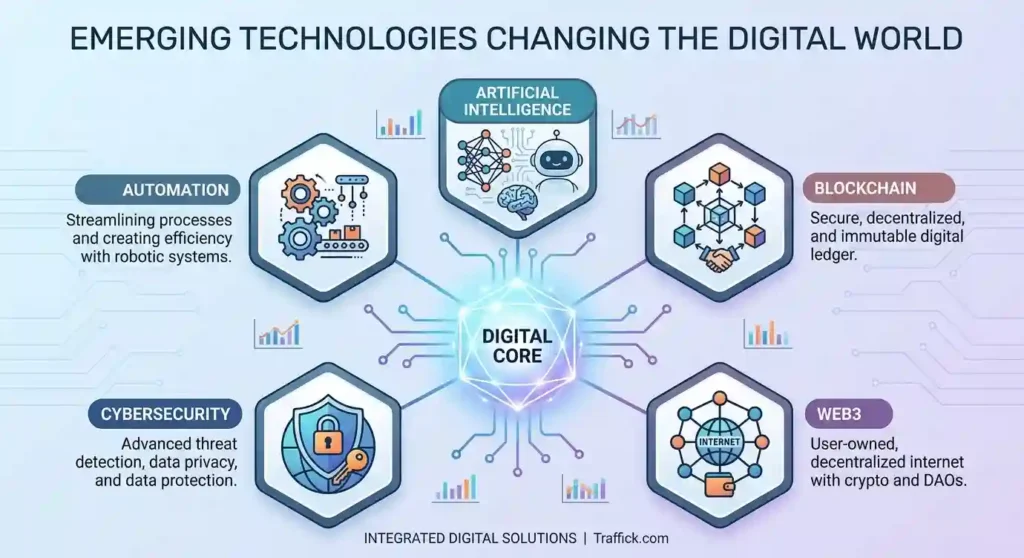
Technology continues to evolve beyond traditional software and devices. Today, Artificial intelligence, blockchain, Web3, automation, and cybersecurity are changing how businesses operate and how people interact with digital systems.
Artificial Intelligence
AI refers to technologies that enable computers to perform tasks that traditionally require human intelligence, such as recognizing patterns, understanding language, making predictions, and generating content.
Generative AI represents one of the most visible developments. These systems can generate text, images, audio, video, code, and other types of content based on user instructions.
Another important development is the rise of AI agents. Instead of only responding to individual prompts, agent-based systems can potentially plan tasks, use tools, make decisions within defined boundaries, and complete multi-step workflows.
Machine learning forms a major part of modern AI. These systems learn patterns from data and use those patterns to make predictions or decisions.
Businesses are applying AI across marketing, customer service, analytics, sales, product development, and operations. Individuals can also use AI to improve productivity, research information, organize work, and automate repetitive tasks.
The future of AI will likely involve deeper integration into everyday software and business processes. However, responsible use remains important, particularly around accuracy, privacy, security, transparency, and human oversight.
Blockchain Technology
Blockchain is a type of distributed digital record system that stores information across a network rather than relying on a single central database. Its structure can make records difficult to alter without detection.
Many people first encountered blockchain through cryptocurrency, but the technology has applications beyond digital currencies. Potential use cases include supply-chain tracking, digital identity, verification systems, asset ownership, financial services, and other record-keeping applications.
Understanding how blockchain works requires looking at concepts such as blocks, transactions, networks, consensus mechanisms, and cryptographic security.
Blockchain can offer benefits such as transparency, shared records, and reduced dependence on a central authority. At the same time, different blockchain systems face limitations involving scalability, complexity, energy use, regulation, usability, and security.
Future developments may focus on making blockchain systems more practical, efficient, interoperable, and accessible.
Web3
Web3 is a broad concept describing a more decentralized approach to online services and digital ownership. While definitions vary, Web3 discussions often involve blockchain networks, decentralized applications, tokens, smart contracts, and user-controlled digital assets.
Decentralized applications, or dApps, can operate using blockchain-based infrastructure rather than depending entirely on a traditional centralized server.
Smart contracts are another important component. They are programs stored and executed on blockchain networks that can automatically carry out predefined actions when specific conditions are met.
Web3 also introduces ideas around digital ownership, where users can hold blockchain-based assets that can potentially move between compatible services.
The technology has significant potential, but it also faces challenges. Usability, regulation, security, scalability, complexity, and adoption remain important issues.
Automation
Automation means using technology to perform tasks with less manual involvement. Businesses have used automation for years, but AI is expanding what automated systems can accomplish.
Business process automation can handle repetitive administrative activities such as data entry, notifications, document processing, and reporting.
Marketing automation can support email campaigns, lead management, customer segmentation, and scheduled communication. AI automation adds capabilities such as content generation, classification, analysis, and decision support.
No-code and low-code platforms make automation accessible to people without advanced programming skills. Users can connect different applications and create workflows using visual interfaces.
Workflow automation can connect several steps together. For example, a new form submission could trigger data storage, an email notification, CRM updates, and a follow-up task.
Productivity automation works on an individual level by reducing repetitive digital tasks. Used correctly, automation can save time and allow people to focus on higher-value work.
Cybersecurity Trends
As businesses become more dependent on digital systems, cybersecurity becomes increasingly important. A security problem can expose sensitive information, interrupt operations, damage reputation, and create financial losses.
Common digital threats include phishing, malware, credential theft, social engineering, account takeovers, and data breaches. Phishing remains particularly dangerous because attackers often try to manipulate people rather than directly attacking technology.
Strong account security starts with unique passwords, password managers, multi-factor authentication, and careful handling of suspicious messages and links.
Data protection also requires appropriate access controls, backups, encryption, security updates, and responsible information handling.
AI is creating both opportunities and risks in cybersecurity. Security teams can use AI to identify unusual behavior and analyze large amounts of information. At the same time, attackers can use AI to create more convincing scams and automate certain malicious activities.
Emerging cybersecurity threats will continue to change as technology develops. Businesses and individuals, therefore, need to treat security as an ongoing process rather than a one-time task.
Practical How-Tos for Digital Marketing & Technology
Understanding concepts is useful, but many readers ultimately want to know how to apply them. This is where practical tutorials and beginner guides connect theory with real-world action.
Tutorials for Beginners
Beginners should avoid trying to learn every digital topic at once. A better approach is to start with a clear goal and learn the skills associated with it.
Someone interested in online business might begin with digital marketing and SEO. Another person may focus on AI tools, SaaS products, automation, social media, or general technology.
Tutorials should break complicated processes into manageable steps. Instead of assuming technical knowledge, beginner-friendly guides should explain what each step does, why it matters, and what to expect.
Beginner Guides
Beginner guides and tutorials are related, but they serve slightly different purposes.
A beginner’s guide usually explains a topic from the ground up. It answers questions such as what something is, why it matters, and what basic concepts readers need to understand.
A tutorial focuses more heavily on completing a specific task. It may show readers exactly how to configure a tool, create a campaign, perform keyword research, or automate a workflow.
Advanced guides assume more knowledge and can explore technical strategies, detailed processes, and complex use cases. Step-by-step walkthroughs sit between explanation and practical instruction by guiding readers through a process from beginning to end.
This structure gives your website room to serve readers at different stages of their learning journey.
How to Choose the Right Digital Tools
With thousands of software products, AI tools, SaaS platforms, gadgets, and automation services available, choosing the right technology can become difficult.
Start by identifying the problem you want to solve. A tool should support a real need rather than simply look impressive.
When evaluating AI tools, consider accuracy, ease of use, privacy, output quality, integrations, and pricing. For SaaS products, look at features, scalability, support, reliability, security, and total cost.
Marketing software should fit your workflow and integrate with the platforms you already use. When choosing gadgets, consider performance, compatibility, durability, battery life, and long-term value.
For automation platforms, check which applications they support and how flexible their workflows are. Security tools require additional attention to reliability, protection, privacy, and ease of management.
Individual reviews and comparison articles can make these decisions easier by examining products according to specific use cases rather than simply listing features.
How to Build a Complete Digital Strategy
A strong digital strategy connects marketing, technology, AI, automation, and security into one practical system. Instead of treating each channel as a separate activity, businesses can build a framework in which each part supports the others.
Step 1 — Define Your Goals
Start with a specific outcome. Your goal might be to increase organic traffic, generate leads, improve sales, build brand awareness, reduce operating costs, or increase productivity.
Clear goals make it easier to choose the right channels and measure progress.
Step 2 — Understand Your Audience
Learn who your customers are, what they need, what problems they face, and how they search for solutions.
Audience research should influence your keywords, content topics, social media strategy, offers, and product decisions.
Step 3 — Build Your SEO Strategy
SEO can provide a sustainable source of organic visibility. Start with keyword research and search intent, then build useful content around topics that matter to your audience.
Technical SEO, on-page optimization, internal linking, and authoritative backlinks can strengthen the overall strategy.
Step 4 — Create Valuable Content
Create content that answers real questions and helps people make decisions. Use blog posts, videos, social content, guides, comparisons, and other formats that align with your audience’s preferences.
Quality matters more than publishing content simply to increase the number of pages on your website.
Step 5 — Build Your Social Media Presence
Choose platforms where your audience actually spends time. Publish useful content consistently, respond to your community, and use analytics to understand what generates meaningful engagement.
Social media should support your broader brand and content strategy rather than operate as a completely separate activity.
Step 6 — Use Paid Advertising Strategically
Paid advertising can accelerate growth when you have a clear offer and a way to measure results. Start with controlled campaigns, track conversions, test different messages, and improve performance based on data.
Avoid spending more simply because a campaign receives clicks. The goal is profitable action.
Step 7 — Choose the Right Technology
Select software, SaaS products, gadgets, analytics platforms, and other tools according to your actual needs.
The best technology is not necessarily the one with the most features. It is the one that solves the problem efficiently and fits your budget and workflow.
Step 8 — Use AI and Automation
AI can assist with research, content, customer service, analysis, and productivity. Automation can automate repetitive tasks and reduce manual work.
Together, they can help businesses save time and scale processes while keeping people involved in important decisions.
Step 9 — Protect Your Digital Assets
Security should be part of the strategy from the beginning. Protect accounts, customer information, websites, devices, and business systems with strong authentication, updates, backups, access controls, and security awareness.
Step 10 — Measure and Improve Performance
A digital strategy should never remain static. Monitor important metrics, identify weak areas, test improvements, and adjust your approach.
Digital growth is an ongoing cycle: plan, create, measure, learn, and improve.
How AI Is Changing Digital Marketing and Technology
AI now overlaps with nearly every part of digital growth. Its impact is not limited to chatbots or content generation. Businesses can use AI to analyze information, personalize experiences, automate workflows, and support decision-making.
AI for SEO
AI can assist with keyword research, topic discovery, content outlines, competitor analysis, internal-link suggestions, and content optimization.
However, AI should support SEO rather than replace strategic thinking. Search-focused content still needs accuracy, originality, useful information, and a clear understanding of search intent.
AI for Content Marketing
AI can speed up brainstorming, research, drafting, editing, repurposing, and content planning. It can also help turn one piece of content into different formats.
Human review remains important because readers need useful, accurate, and original information rather than generic AI-generated text.
AI for Social Media
AI can help generate post ideas, captions, content variations, publishing plans, and performance insights. Businesses can use these capabilities to maintain a more consistent social presence.
The strongest results still come from combining AI efficiency with genuine human interaction.
AI for Paid Advertising
Advertising platforms increasingly use AI to help with audience targeting, campaign optimization, bidding, creative testing, and performance analysis.
Marketers can use AI to identify patterns and test ideas faster, while human oversight keeps campaigns aligned with business goals.
AI for Affiliate Marketing
Affiliate marketers can use AI for niche research, content planning, product comparisons, keyword discovery, and content optimization.
The key is adding genuine experience and useful analysis. AI-generated affiliate pages without meaningful value can erode trust rather than build it.
AI for Business Automation
AI can make automation more flexible by helping systems understand text, classify information, generate responses, summarize data, and support decisions.
This can turn simple automated workflows into more intelligent processes.
AI-Powered Software and SaaS
AI is becoming a standard feature across many SaaS products. Project management, customer relationship management, marketing, writing, analytics, design, and productivity platforms increasingly include AI capabilities.
This means users may not always need a separate AI tool for every task. AI functionality may become part of the software they already use.
The Future of AI-Powered Digital Growth
The future will likely involve deeper connections between AI, search, software, automation, marketing, and business operations.
Instead of using AI as a separate tool, businesses may increasingly treat it as a layer that supports multiple parts of their digital infrastructure.
Important Digital Marketing & Technology Metrics
Metrics help turn digital activity into measurable results. Without tracking performance, businesses may spend time and money without knowing what actually works.
SEO Metrics
Organic traffic shows how many visitors arrive through unpaid search results. Rankings indicate where pages appear for target queries, while CTR (Click-Through Rate) measures how often people click a search result after seeing it.
Backlinks can provide signals of authority and help search engines discover and evaluate pages. Ultimately, conversions show whether organic traffic produces meaningful business results.
Marketing Metrics
A conversion rate measures the percentage of users who complete a desired action. CPC (Cost Per Click) shows how much an advertiser pays for clicks, while CPA (Cost Per Acquisition) measures the cost of generating a conversion.
ROAS evaluates revenue generated from advertising spend, while ROI considers the broader return after accounting for relevant costs.
Content Metrics
Content performance can include engagement, traffic, time on page, shares, and leads.
Traffic shows whether people discover the content. Engagement indicates how users interact with it, while time on page provides additional context about user behavior. Shares can indicate that people find content valuable enough to distribute, and leads connect content performance to business outcomes.
Technology Metrics
Technology performance can be measured through several factors, including performance, cost, productivity, adoption, and security.
A tool might offer excellent features but still provide poor value if it costs too much or creates unnecessary complexity. Businesses should therefore evaluate technology according to both technical performance and practical business impact.
The Future of Digital Marketing and Technology
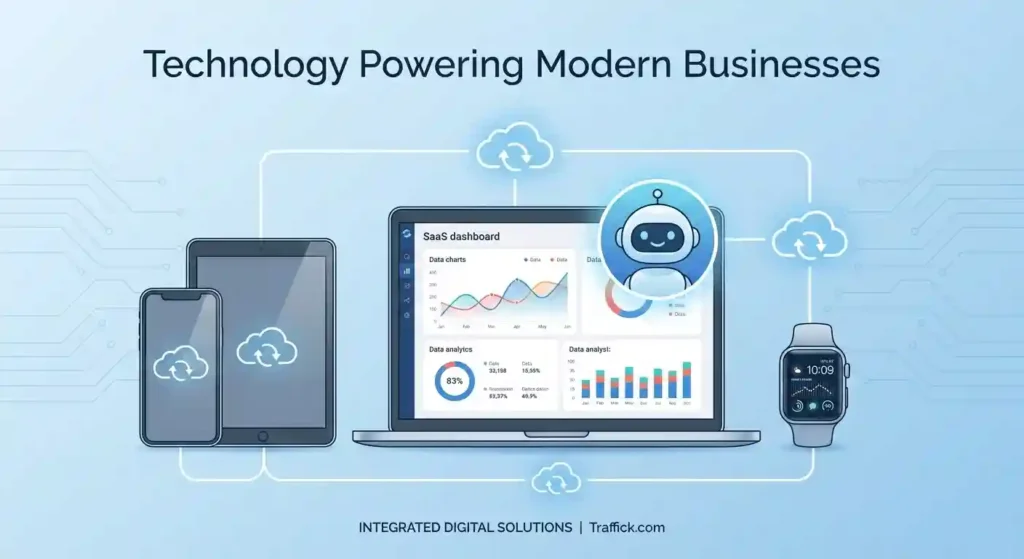
Digital marketing and technology are moving toward greater integration. Search, social media, AI, automation, SaaS, cybersecurity, Web3, and other emerging technologies increasingly influence one another.
AI can improve marketing workflows. Automation can connect different software systems. SaaS can make advanced capabilities accessible to smaller businesses. Cybersecurity becomes more important as organizations rely on more connected systems.
Search itself is also evolving as users interact with new types of AI-powered experiences and as discovery platforms change. Social media continues to influence brand discovery, while emerging technologies may create new ways to communicate, transact, and manage digital assets.
The important lesson is not to chase every new trend. Businesses should understand how technology solves real problems and adopt useful developments when they support clear goals.
Detailed trend articles can explore each development in greater depth, while this cornerstone guide provides the broader picture.
Conclusion
Digital growth does not come from a single tool or marketing channel. It develops through the connection between digital marketing, technology, AI, automation, and practical implementation.
Digital marketing helps businesses attract and engage audiences. Technology provides the software, devices, and platforms that make modern operations possible. AI adds new ways to create, analyze, automate, and personalize digital experiences. Automation connects repetitive processes and helps teams work more efficiently. Finally, practical how-to guides turn these ideas into actions that beginners and experienced users can apply.
This cornerstone article provides the bigger picture, but every topic deserves deeper exploration. Readers can continue from here into the individual Digital Marketing, Tech Reviews, Emerging Tech, and How-Tos pillars and then explore focused guides on SEO, social media, content marketing, paid advertising, affiliate marketing, AI, blockchain, Web3, automation, cybersecurity, software, SaaS, gadgets, and practical tutorials.
Together, these resources create a connected learning path—from understanding digital growth to choosing the right technology and building a smarter, more effective digital strategy.
Frequently Asked Questions
How can businesses create an effective digital marketing strategy?
An effective strategy starts with clear goals and a defined target audience. Businesses should then choose the right channels, create useful content, use SEO and paid marketing where appropriate, and track results to improve performance over time.
How is AI changing digital marketing and modern technology?
AI is making digital marketing and technology faster and more personalized by automating repetitive tasks, analyzing customer behavior, creating content, and improving decision-making. It also helps businesses use chatbots, predictive analytics, automation, and AI-powered tools to improve efficiency.
Which emerging technologies and digital trends should businesses focus on next?
Businesses should pay attention to AI and automation, advanced data analytics, cloud technology, cybersecurity, blockchain, and emerging search trends. Focusing on technologies that improve efficiency, customer experience, data security, and online visibility can help businesses stay competitive as digital markets evolve.
What are the most important areas of digital marketing?
The major areas include SEO, content marketing, social media marketing, paid advertising, email marketing, and affiliate marketing. The right combination depends on the business, audience, goals, budget, and industry.
How does SEO help a business?
SEO helps businesses improve their visibility in search engines and attract relevant organic traffic. A strong SEO strategy can bring visitors to useful pages without requiring the business to pay for every click.
How can beginners learn digital marketing?
Beginners should start with the fundamentals and choose one area at a time. Learning through beginner guides, tutorials, practical projects, and real examples can make concepts easier to understand and apply.
How can AI be used in digital marketing?
AI can support keyword research, content planning, writing assistance, social media, advertising analysis, customer support, personalization, and automation. Human review remains important for accuracy, strategy, and quality.

One Comment