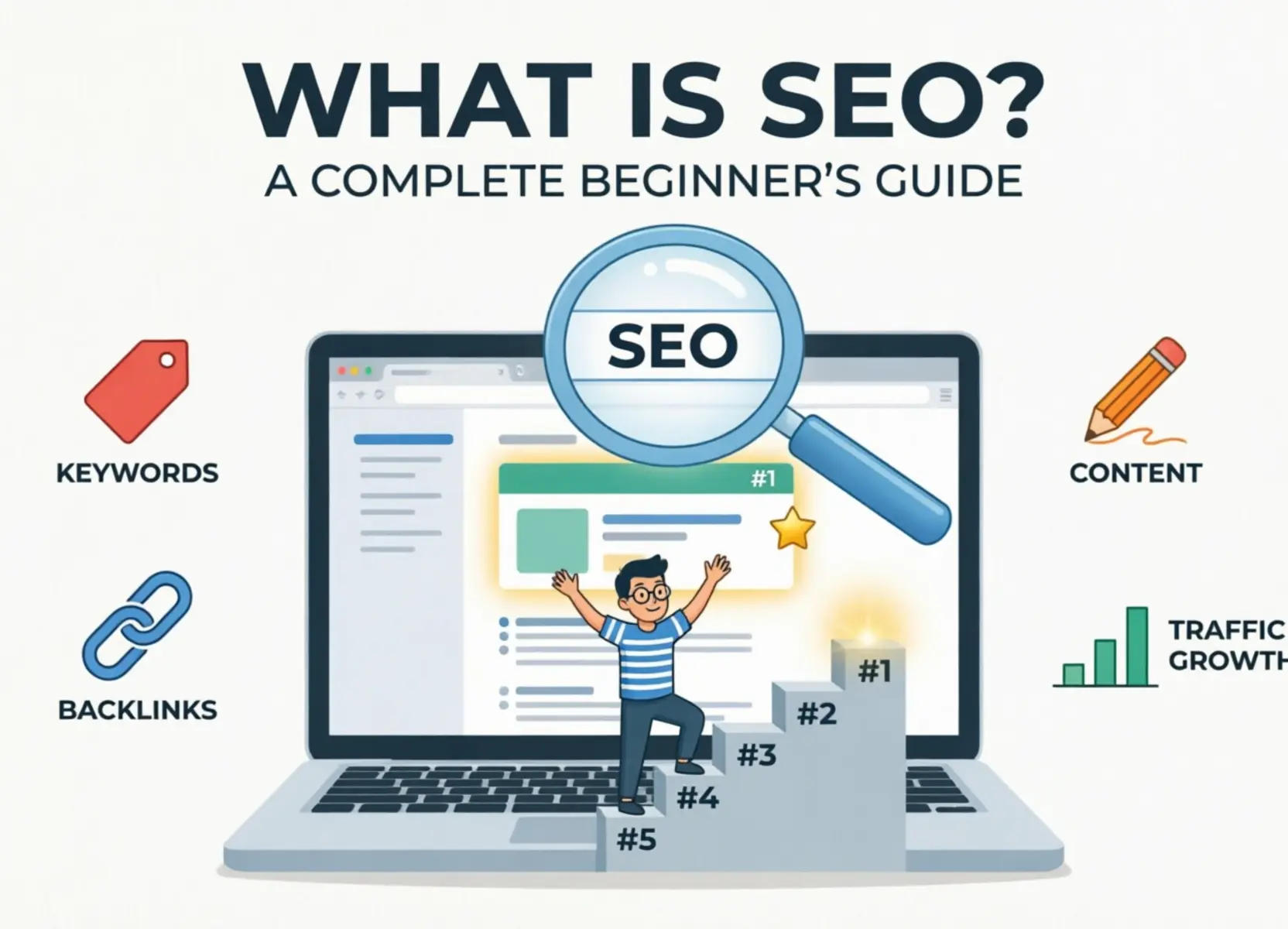
What Is SEO? A Complete Beginner’s Guide
Search Engine Optimisation is the process of improving your website so that it ranks higher in search engine results like Google and Bing. A well-optimized website attracts more organic traffic, builds trust with users, and increases opportunities for leads and sales without relying only on paid advertising.
This complete beginner’s guide to SEO explains everything you need to know, including how search engines work, why SEO matters, different types of SEO, important ranking factors, and practical strategies to improve your website’s visibility. Whether you own a business, run a blog, or are just starting your digital marketing journey, learning SEO is one of the most valuable skills for achieving long-term online success.
What Is SEO?
Search Engine Optimisation is the process of improving a website so that it ranks higher on search engines like Google, Bing, and Yahoo. The main goal of Search Engine Optimisation is to increase organic (unpaid) traffic by making your website more relevant, useful, and trustworthy.
For example, if someone searches for “best running shoes” on Google, it helps the most relevant websites appear near the top of the search results.
Unlike paid advertisements, it focuses on earning traffic naturally over time.
How Does Search Engine Optimisation Work?
Many beginners ask, how does SEO work? Search engines use automated programs called crawlers or spiders to discover and index web pages.
After a page is indexed, Google’s algorithm analyzes hundreds of ranking factors, including:
- Content quality
- Keyword relevance
- Website speed
- Mobile friendliness
- User experience
- Backlinks
- Website security (HTTPS)
As a result, Google ranks pages that provide the best answer to the user’s search query.
Why Is Search Engine Optimisation Important?
SEO offers several benefits for websites and businesses.
- Increases website traffic
- Improves brand awareness
- Builds trust and credibility
- Generates quality leads
- Delivers long-term results
- Provides a better return on investment than many advertising methods
Therefore, businesses of all sizes invest in SEO to grow their online presence.
The Four Pillars of Modern SEO
Modern SEO is built on four essential pillars that work together to improve website performance.
- Technical SEO
- On-page SEO
- Off-page SEO
- User Experience (UX)
Types of SEO
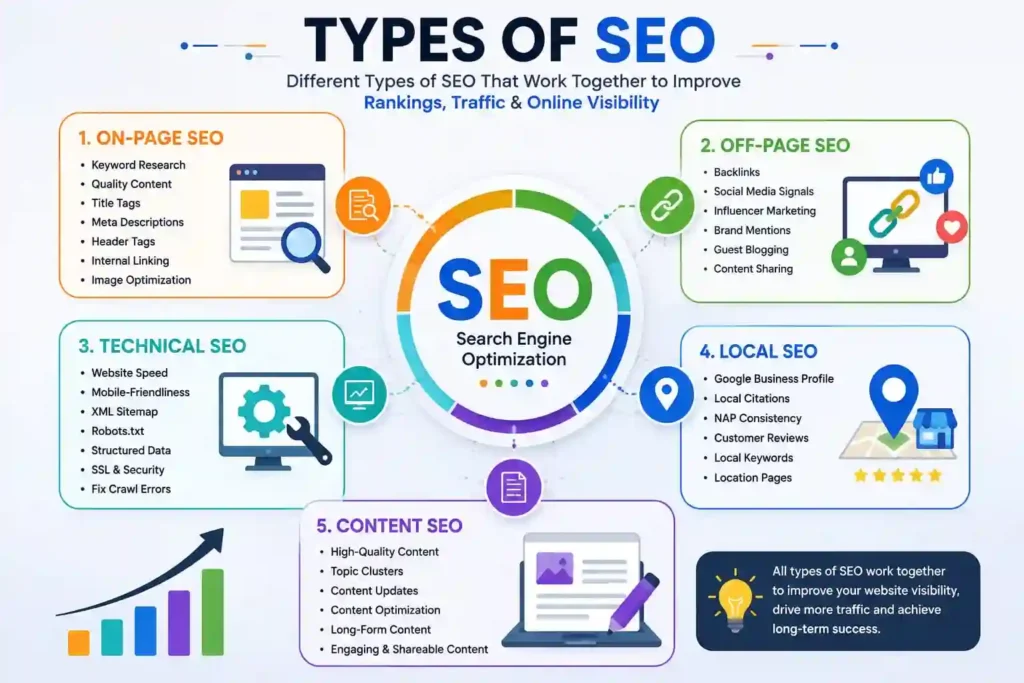
SEO is generally divided into three main categories.
On-page SEO
On-page SEO includes everything you optimise on your website.
Examples include:
- Writing high-quality content
- Using keywords naturally
- optimising headings
- Writing SEO-friendly URLs
- Adding internal links
- Optimising images
- Writing effective meta titles and descriptions
Off-page SEO
Off-page SEO refers to activities performed outside your website to improve its authority.
Common off-page SEO strategies include:
- Building quality backlinks
- Guest posting
- Social media promotion
- Brand mentions
- Influencer outreach
High-quality backlinks from trusted websites signal to Google that your content is valuable.
Technical SEO
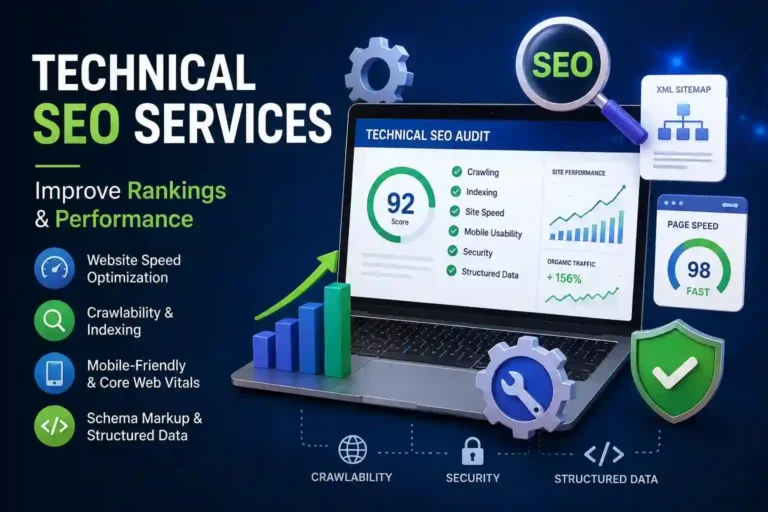
Professional technical SEO ensures that search engines can crawl, index, and understand your website efficiently.
Modern technical SEO includes:
- Improving page speed
- Mobile optimisation
- XML sitemaps
- Robots.txt
- Structured data (Schema Markup)
- Fixing broken links
- HTTPS security
- Core Web Vitals optimisation
Without strong technical SEO, even excellent content may struggle to rank well.
What are the SEO Ranking Factors?
Google uses many ranking factors to determine which pages deserve higher positions in search results. Some of the most important include:
- High-quality and helpful content
- Search intent satisfaction
- Relevant keyword usage
- website speed
- Mobile-friendly design
- Backlinks from authoritative website
- Secure HTTPS connection
- Core Web Vitals
- Internal linking
- User experience
- Fresh and updated content
- Website authority
Although no one knows Google’s complete algorithm, focusing on these factors can significantly improve your rankings.
Learn SEO Step by Step
If you’re wondering how to learn SEO step by step, follow this simple roadmap:
Step 1: Understand Search Intent
Learn why users search for specific topics.
Step 2: Perform Keyword Research
Find keywords with good search volume and low competition.
Step 3: Create Helpful Content
Write content that solves real problems and answers user questions.
Step 4: Optimise On-page SEO
Use your keywords naturally in headings, titles, URLs, and content.
Step 5: Improve Technical SEO
Ensure your website loads quickly and works well on mobile devices.
Step 6: Build Backlinks
Earn links from trusted websites through quality content and outreach.
Step 7: Monitor Performance
Use SEO tools to track rankings, traffic, and website performance.
SEO and AI Search: The Future of Search Optimisation
Search is evolving rapidly with the rise of artificial intelligence. Users increasingly receive direct answers through AI-powered search features instead of simply browsing a list of links. Nevertheless, SEO remains essential because AI systems still rely on trustworthy, well-optimised content.
The future of search optimisation combines traditional SEO with AI-focused strategies such as GEO and AEO. Businesses should create original, high-quality content, demonstrate expertise, improve technical performance, and answer users’ questions clearly. By doing so, they can increase their visibility in both traditional search results and AI-generated responses, ensuring long-term success in the changing digital landscape.
What Are Organic SEO Services?
Organic SEO services focus on improving search rankings naturally without paying for advertisements.
These services often include:
- Keyword research
- Technical SEO audits
- Content optimisation
- Link building
- On-page SEO
- Off-page SEO
- Website performance improvements
Although organic SEO takes time, it provides long-lasting and cost-effective results.
What is White Hat SEO vs White Label SEO
| Feature | White Hat SEO | White Label SEO |
| Defination | White hat refers to ethical SEO practices that follow search engine guidelines. | White label is a service where one SEO agency performs SEO work for another company, which then sells it under its own brand. |
| Purpose | Improve search rankings through ethical, long-term strategies. | Help agencies offer SEO services without building an in-house SEO team. |
| Who uses it | Website owners, bloggers, businesses | Digital marketing agencies, web design agencies, and freelancers. |
| Example | Creating original content, optimising website speed, and using keywords naturally. | Outsourcing keyword research, link building, content creation, and SEO reporting. |
| Benefits | sustainable growth, higher search rankings, better user experience, and compliance with search engine guidelines. | Saves time, reduces costs, expands service offerings, and allows agencies to focus on client relationships. |
| Long-term impact | Building lasting authority and organic traffic. | Helps agencies scale their business while delivering professional SEO services under their own brand |
| Best for | Anyone who wants to improve a website’s search rankings ethically. | Agencies that want to provide SEO services without hiring a dedicated team. |
Common SEO Mistakes Beginners Should Avoid
Even experienced marketers can make mistakes. Here are some common ones:
- Keyword stuffing
- Publishing low-quality content
- Ignoring mobile users
- Not optimising page speed
- Forgetting internal links
- Buying low-quality backlinks
- Skipping images optimisation
- Neglecting technical SEO
Avoiding these mistakes can improve your website’s performance and user experience.
Best SEO Tools for Beginners
To make SEO easier, consider using these popular tools:
- Google Search Console
- Google Analytics
- Google Keyword Planner
- Google Trends
- Yoast SEO
- Ahrefs
- SEMrush
- Moz
These tools help with keyword research, performance tracking, technical audits, and content optimisation.
Conclusion
SEO is one of the most effective ways to grow your website, attract more visitors, and build a strong online presence. By understanding SEO for beginners, learning how SEO works, and applying proven SEO techniques, you can improve your rankings and reach your target audience.
In this SEO beginner’s guide, we discussed that SEO is a long-term strategy. Focus on creating valuable content, following white-hat SEO practices, improving technical SEO, strengthening off-page SEO, and using organic SEO services when appropriate. Most importantly, continue learning and adapting as search engines evolve. With patience and consistent effort, you can build lasting success in search results.
Frequently Asked Questions
1. Is SEO free?
Yes, SEO can be free because you can optimise your website, create quality content, and improve rankings without paying for ads. However, some businesses invest in SEO tools or professional SEO services to achieve faster and more effective results.
2. How long does SEO take?
SEO is a long-term strategy, and results usually take 3 to 6 months to become noticeable. The timeline depends on your website’s age, competition, content quality, and the effectiveness of your SEO efforts.
3. Can I learn SEO without experience?
Yes. Anyone can learn SEO without prior experience by studying SEO basics, practising on a website, and using free learning resources. With consistent practice and hands-on experience, beginners can gradually develop strong SEO skills.
4. Is technical SEO necessary?
Yes. Technical SEO is essential because it helps search engines crawl, index, and understand your website. It also improves website speed, mobile usability, security, and overall user experience, all of which contribute to better search rankings.
5. Which is better: SEO or paid advertising?
Both have their advantages. SEO delivers long-term organic traffic and sustainable growth, while paid advertising provides immediate visibility and faster results. Many businesses achieve the best outcomes by combining SEO with paid advertising as part of their digital marketing strategy.




One Comment