What is Topical Authority in SEO? The Ranking Secret
Imagine you have two websites competing for the same keyword.
One website has published a single 1,000-word article about the topic. The other has dozens of genuinely useful articles covering the main subject, related questions, subtopics, examples, comparisons, and practical solutions—all connected in a logical structure.
Which website would you trust more?
That is where topical authority comes into the conversation.
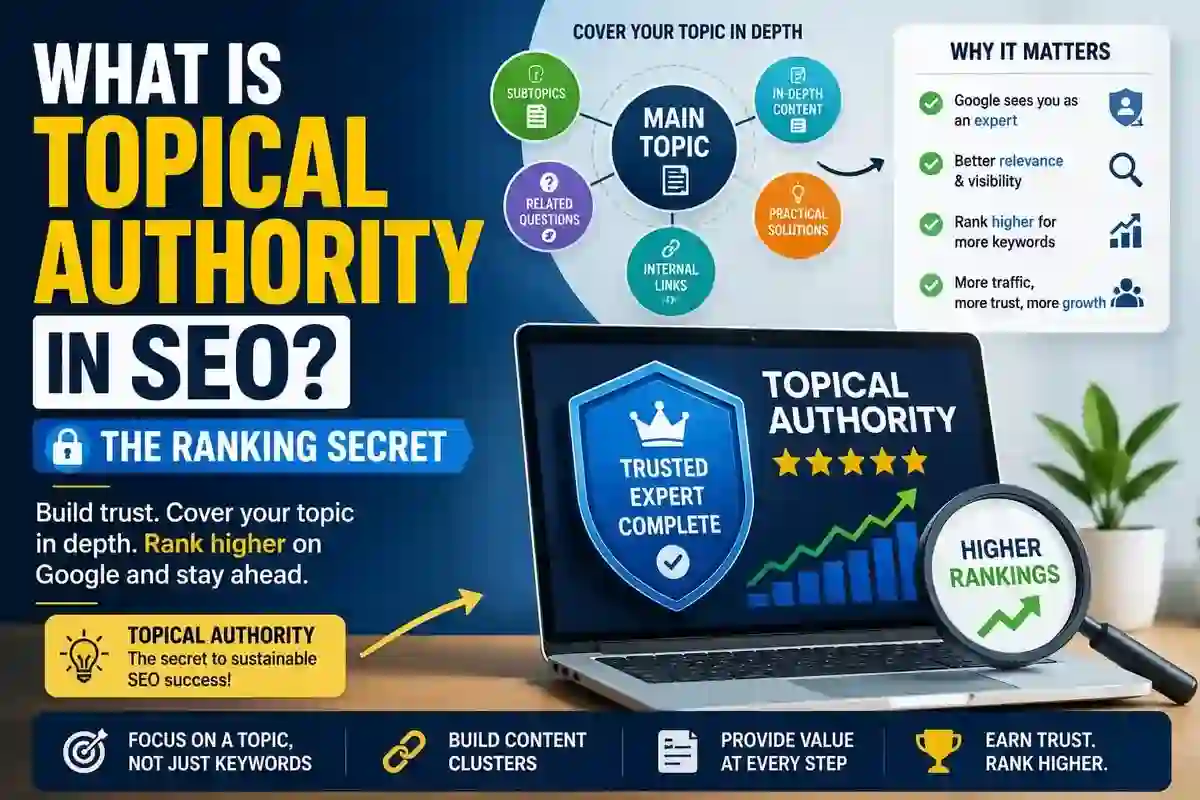
In SEO, topical authority for a website refers to the depth and breadth of useful coverage it provides on a particular subject. Instead of creating random articles just because they have search volume, you build a connected library of content that thoroughly serves your audience’s needs.
However, topical authority is not simply about publishing hundreds of articles or repeating the same keyword. Google says its systems prioritize helpful, reliable, people-first content and advises creators to provide substantial, comprehensive information that adds real value. So, what is topical authority in SEO, how does it work, and how can you build it?
What Is Topical Authority in SEO?
Topical authority in SEO is the level of expertise and coverage a website appears to demonstrate around a specific subject.
For example, suppose you have a website about SEO. Publishing one article titled “What Is SEO?” gives you coverage of only one broad topic.
But imagine your website also covers:
- Keyword research
- Search intent
- On-page SEO
- Technical SEO
- Internal linking
- Semantic SEO
- Topic clusters
- Content optimization
- Link building
- Core Web Vitals
- SEO analytics
- Local SEO
Now your website provides much broader topical coverage.
The important part, however, is not simply the number of articles. Each article should genuinely help the reader and connect logically with related content.
Google’s guidance specifically encourages content that is substantial, comprehensive, original, well-organized, and created primarily to help people rather than manipulate rankings.
Why Is Topical Authority Important for SEO?
Search engines need to understand what your website and individual pages are about.
When your website consistently publishes high-quality information around a focused subject, it becomes easier for users to explore related information and for search engines to understand the relationships between your pages.
For example, if your main topic is content marketing, you might cover:
- What is content marketing?
- Content marketing strategy
- Content marketing funnel
- Content research
- Content writing
- Content distribution
- Content promotion
- Evergreen content
- Content analytics
Instead of having isolated articles, you create a connected knowledge base. Moreover, a strong topical structure can improve the user journey. Someone reading about content strategy can easily move to your article about content distribution, then to content promotion.
Google explains that logical site structure and relevant internal links can help its systems understand the relationships between pages and identify important content
Topical Authority vs. Keyword Stuffing
This is where many beginners get confused.
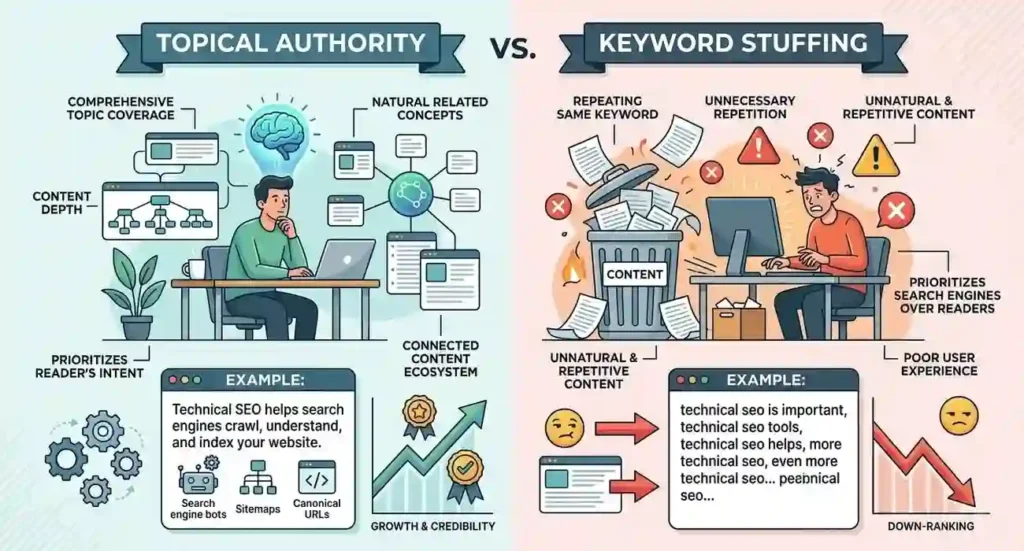
This creates content depth and topical coverage by addressing the different questions a reader may have.
Google’s Search Essentials recommends using the words people use to search for your content, but its broader guidance emphasizes helpful, people-first content over search-engine-first writing.
How to Build Topical Authority
Building topical authority is a process, not a one-time SEO trick. Here is a practical topical authority strategy you can follow.
1. Choose a Clear Main Topic
First, decide what subject you want your website to become known for.
For example:
- SEO
- Digital marketing
- Social media marketing
- Personal finance
- Fitness
- Online education
- Technology
Avoid trying to become an expert in everything. A focused website makes it easier to build meaningful topical coverage.
2. Understand Search Intent
Before creating an article, understand search intent. Ask: What does the person actually want to know?
For example, someone searching: “What is technical SEO?”
Probably wants a beginner-friendly explanation.
Someone searching: “technical SEO audit checklist”
Probably wants an actionable checklist.
Someone is searching: “technical SEO agency”
May have commercial intent.
Therefore, don’t create content simply because a keyword has search volume. Create content that satisfies the reason behind the search.
3. Build Topic Clusters
One of the most useful ways to organize topical coverage is through topic clusters. A topic cluster usually contains:
Main topic → supporting subtopics → related detailed articles
For example:
Main Topic: SEO
Supporting topics might include:
- Keyword Research
- Technical SEO
- On-Page SEO
- Off-Page SEO
- Local SEO
- Semantic SEO
Each supporting topic can then have its own related articles. This structure creates relationships between your content instead of leaving every article isolated.
4. Use Internal Linking Strategically
Internal linking is another important part of building a well-connected website. Suppose you write an article about keyword research and mention search intent.
Instead of leaving the concept unexplained, you could link to your detailed article about search intent.
For example, understanding search intent is essential when choosing keywords for your content.
Then link “search intent” to your dedicated guide. Use descriptive anchor text instead of generic phrases such as:
- Click here
- Read more
- This article
Google recommends concise, relevant anchor text because it helps users understand what they will find when they follow a link.
5. Improve Content Depth
Content depth doesn’t mean making every article extremely long. In fact, Google explicitly says creators should not write to a particular word count simply because they believe Google has a preferred length.
Instead, ask: Have I answered the important questions my reader is likely to have?
For example, an article about “What Is SEO?” may need to explain:
- What SEO means
- How search engines work
- Types of SEO
- Why SEO matters
- Keyword research
- On-page optimization
- Technical SEO
- Link building
- Measuring SEO performance
- Common SEO mistakes
If these sections genuinely help the reader, they contribute more to topical coverage than adding unnecessary paragraphs.
6. Create Authoritative Content
Your goal should be to create authoritative content, not merely content that sounds authoritative.
Add useful elements such as:
- Original examples
- Practical steps
- Real-world scenarios
- Relevant data
- Expert explanations
- First-hand experience where applicable
- Clear sources for important claims
- Helpful screenshots or illustrations
- Updated information
Google’s current guidance encourages creators to demonstrate expertise and make it clear who created the content, especially when that information helps readers understand why they should trust the source.
What Is Pillar Content?
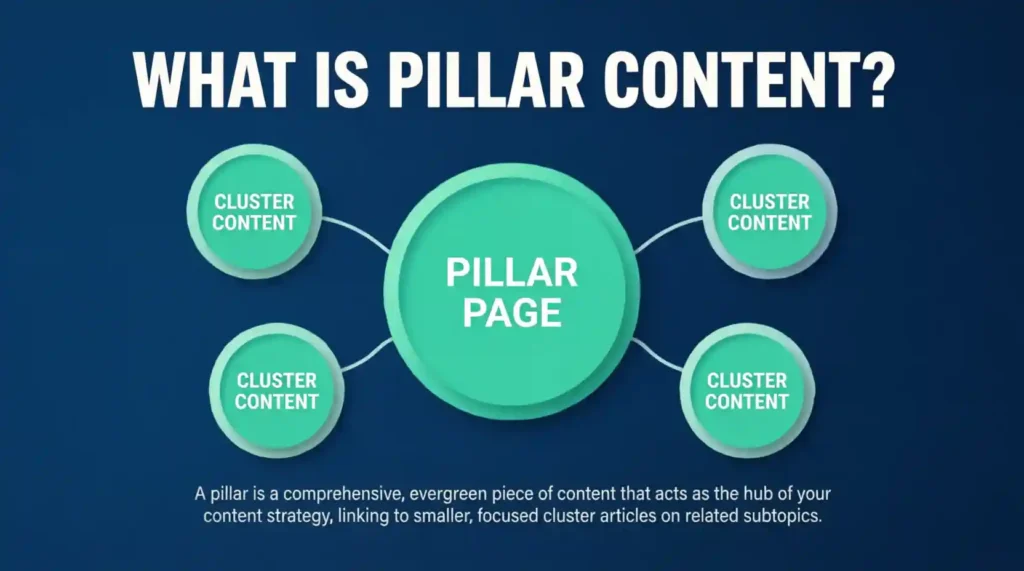
Pillar content is a comprehensive resource that covers a broad topic while connecting readers to more detailed supporting articles. Think of pillar content as the central hub of your topic.
For example: Pillar Content
Complete Guide to SEO for Beginners
Supporting articles:
- What Is Keyword Research?
- What Is Search Intent?
- What Is Technical SEO?
- What Is On-Page SEO?
- What Is Internal Linking?
- What Is Semantic SEO?
The pillar page provides a broad overview, while supporting articles go deeper into individual subjects. This structure can be especially useful for large websites because it helps visitors discover related information.
Pillar Content and Supporting Content
A good topic cluster can look like this:
Pillar Content: SEO Guide
Supporting Content:
- Keyword Research Guide
- Search Intent Guide
- On-Page SEO Guide
- Technical SEO Guide
- Internal Linking Guide
- Semantic SEO Guide
More Detailed Content:
- Long-Tail Keywords
- Keyword Difficulty
- Canonical Tags
- XML Sitemaps
- Topic Clusters
- Anchor Text
- Entity SEO
The goal is not to create pages just to fill a structure. Every supporting page should answer a real question or solve a real problem.
What Is Semantic SEO?
Semantic SEO focuses on meaning, concepts, relationships, and context rather than relying solely on exact-match keywords.
For example, if your main topic is “SEO,” semantically related concepts may include:
- Search engines
- Crawling
- Indexing
- Keywords
- Search intent
- Rankings
- Backlinks
- Content
- Technical optimization
You don’t need to force every related term into your article. Instead, discuss concepts naturally when they help explain the topic. This makes your content more complete and useful to readers.
Topical Authority Example
Let’s say you run a website about digital marketing.
Your main pillar content could be:
Complete Guide to Digital Marketing
Then you create topic clusters around:
SEO
- Keyword Research
- Technical SEO
- On-Page SEO
- Semantic SEO
Content Marketing
- Content Strategy
- Content Writing
- Content Promotion
- Evergreen Content
Social Media Marketing
- Social Media Strategy
- Social Media Content
- Social Media Advertising
- Social Media Analytics
Email Marketing
- Email Campaigns
- Email Automation
- Email Copywriting
- Lead Nurturing
Now your website isn’t simply publishing unrelated marketing articles. It is building a structured resource around digital marketing.
Common Topical Authority Mistakes
Building topical authority sounds simple, but several mistakes can weaken your strategy.
Publishing Too Many Random Topics
Writing about SEO today, recipes tomorrow, cryptocurrency next week, and travel the week after can make your website’s overall focus unclear.
Creating Thin Supporting Articles
Don’t publish a 300-word article just because a keyword exists. If the topic deserves a useful explanation, provide one.
Repeating the Same Information
Ten articles that say almost exactly the same thing don’t create meaningful topical coverage.
Ignoring Search Intent
A page can target the right keyword but still fail to satisfy the searcher’s actual goal.
Overusing Keywords
Keyword stuffing makes content unnatural and can damage the reading experience.
Forgetting Internal Links
Great content that is disconnected from the rest of your website misses an opportunity to help users discover related information.
Conclusion
So, what is topical authority in SEO? It is best understood as a website’s depth, breadth, and usefulness around a particular subject—not simply a collection of pages containing the same keywords.
A strong strategy combines pillar content, topic clusters, internal linking, search intent, content depth, topical relevance, semantic SEO, and genuinely helpful information. Most importantly, don’t build topical authority just to get Google to rank your pages. Build it because your audience needs a reliable place to understand a subject from multiple useful angles.
Google’s own guidance consistently emphasizes creating helpful, reliable, people-first content and a logical website structure.
Frequently Asked Questions (FAQs)
1. Does topical authority guarantee higher Google rankings?
No. Building topical authority does not guarantee higher rankings. Google considers many signals and emphasizes helpful, reliable, people-first content. However, comprehensive and relevant content can support a strong SEO strategy.
2. How does internal linking help topical authority?
Internal linking connects related pages on your website. It helps users discover relevant information and can help search engines understand the relationships and hierarchy between your pages.
3. How long does it take to build topical authority?
There is no fixed timeframe. It depends on factors such as your website’s size, competition, content quality, topic coverage, website history, and consistency. Building meaningful topical coverage is a long-term process.
4. How many articles are needed to build topical authority?
There is no specific number of articles required. Quality and relevance are more important than publishing a certain number of posts. Create content based on the important questions and subtopics your audience actually needs.
5. Can a new website build topical authority?
Yes. A new website can gradually build topical authority by choosing a focused niche, creating genuinely helpful content, covering related subtopics, and building a logical internal-linking structure