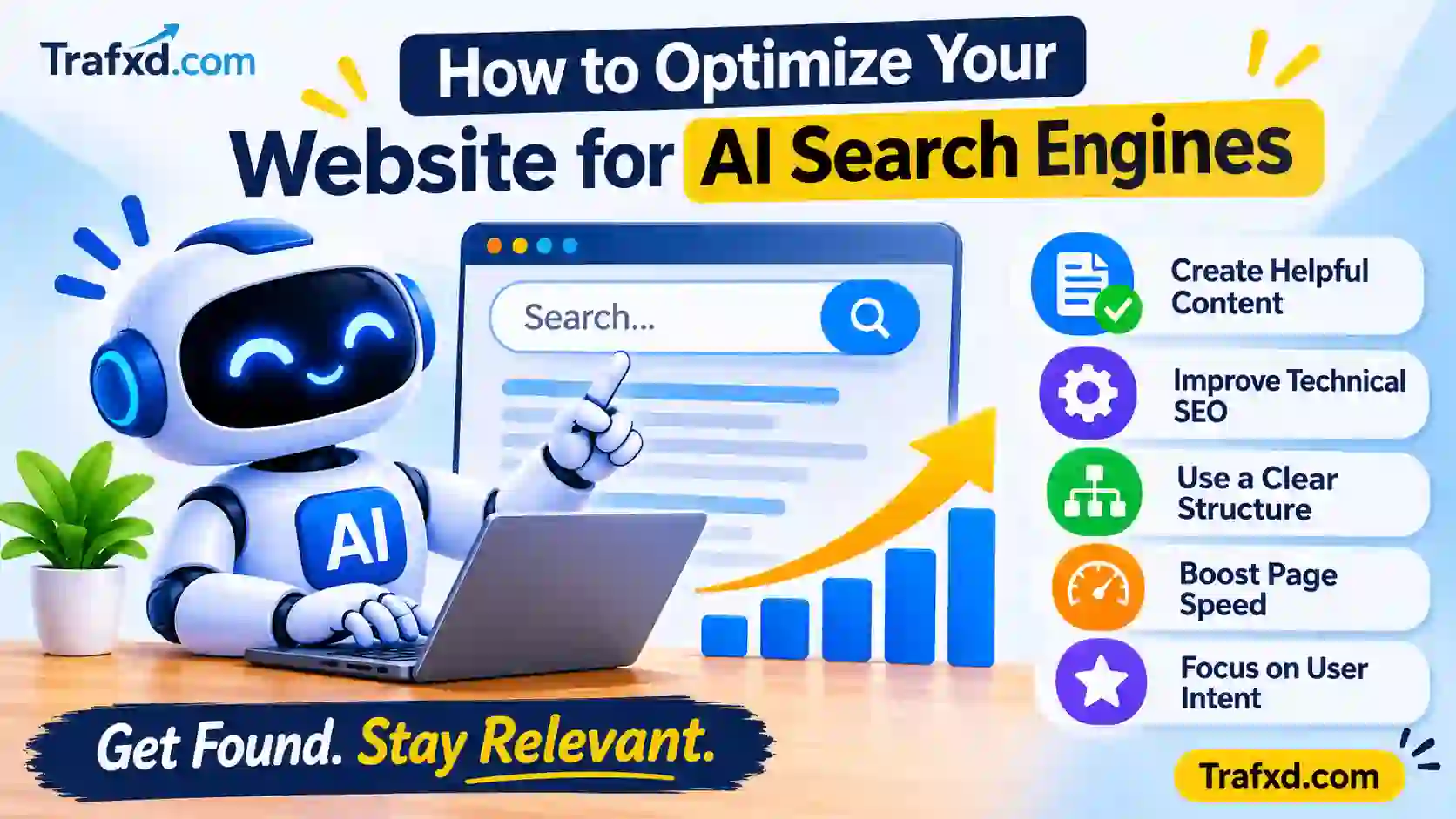
How to Optimize Your Website for AI Search Engines
Search is changing. People no longer rely only on traditional search engines to find information. They are also asking AI-powered platforms such as ChatGPT, Google AI Overviews, and Microsoft Copilot to explain topics, compare products, and recommend solutions.
For website owners, this creates an important question: How can you make your website easier for AI-powered search experiences to discover, understand, and reference?
The answer is not to abandon traditional SEO or fill your website with AI-generated content. Instead, you need a website that delivers useful information, demonstrates credibility, and makes its content accessible to search engines. If you’re new to the fundamentals, start with our SEO Complete Beginner’s Guide before diving into AI search optimization.
In this guide, you will learn how to optimize your website for AI search, improve your content structure, strengthen your online credibility, and build a practical strategy for long-term visibility.
What Is AI Search Optimization?
AI search optimization is the process of improving your website’s content, structure, and credibility so that AI-powered search experiences can discover and understand your information and potentially reference it in their responses.
Traditional search engines typically present a list of webpages in response to a query. AI-powered search experiences can also generate conversational answers, summarize information, and provide supporting sources.
For example, someone might search for “best SEO tools for small businesses.” Instead of reviewing several websites individually, they might ask an AI search platform to compare tools, explain their features, and recommend suitable options.
If your website publishes accurate, relevant, and well-organized information, it may have an opportunity to be referenced in these experiences.
However, there is no guaranteed method to make an AI platform mention your website. Visibility depends on several factors, including the platform, the user’s query, available sources, and the quality and accessibility of your information.
1. Create Helpful Content That Answers Real Questions
Your content is one of the most important parts of your AI search strategy.
If an article discusses a topic without answering the reader’s actual question, it is unlikely to provide much value. Instead of writing primarily to include keywords, focus on solving a specific problem.
For example, an article about website optimization could answer questions such as:
- How can I improve my website’s visibility in AI search?
- Does AI search optimization require technical SEO?
- How can I make my content easier for AI systems to understand?
- Can small websites appear in AI-generated answers?
Answer these questions clearly and support your explanations with practical examples.
Focus on usefulness rather than word count
A 1,500-word article that solves a problem can be more useful than a 3,000-word article filled with repetition.
Before publishing, ask yourself:
- Does the article answer the main question?
- Can readers apply the advice?
- Are the examples realistic?
- Have I removed unnecessary explanations?
- Is the information accurate and current?
Google’s guidance emphasizes helpful, reliable, people-first content. These principles are a sensible foundation for AI search optimization as well.
2. Structure Your Content So It Is Easy to Understand
Even valuable information can be difficult to follow when it appears in large, unorganized paragraphs.
A clear content structure helps readers navigate your article and makes the relationships between different ideas easier to understand. Use one descriptive H1 heading for your main title, followed by relevant H2 headings and H3 subheadings.
For example:
- H1: How to Optimize Your Website for AI Search Engines
- H2: What Is AI Search Optimization?
- H2: How to Improve Your Website’s AI Search Visibility
- H3: Write Clear, Informative Answers
- H3: Improve Your Website’s Technical Accessibility
- H2: Common AI Search Optimization Mistakes
Keep paragraphs focused on one main idea. Use bullet points for practical steps and tables when a comparison genuinely helps.
You can also answer important questions directly near the beginning of a section before explaining the details.
For example:
Question: Does AI search optimization replace traditional SEO?
Answer: No. Technical accessibility, useful content, relevant information, and website credibility remain important. AI search optimization builds on these foundations rather than replacing them.
This approach makes your article easier to read without relying on tricks or unnatural keyword placement.
3. Strengthen Your Traditional SEO Foundations
AI search optimization does not eliminate the need for a technically sound website.
Search systems need to access and process your content before it can become a candidate for discovery or citation. If important pages are blocked, inaccessible, or poorly structured, your visibility may suffer.
Start with these essential checks:
Check your robots.txt file: Make sure it does not unintentionally block important pages or the search crawlers you want to access your content.
Review your indexing status: Use Google Search Console to identify indexing problems and understand whether your important pages are eligible to appear in Google Search.
Submit your XML sitemap: A sitemap helps search engines discover important URLs, although submission does not guarantee indexing.
Use descriptive URLs: A URL such as `/ai-search-optimization/` is easier to interpret than a long, unclear URL containing unnecessary parameters.
Improve website speed and usability: Ensure your website works well on mobile devices, loads reliably, and provides a comfortable reading experience.
Fix broken internal links: Make sure readers and crawlers can move between relevant pages without encountering unnecessary errors.
One important distinction: being indexed by Google does not guarantee inclusion in AI-generated answers. Likewise, appearing in traditional search results does not guarantee an AI citation.
Your objective is to remove technical barriers and make your content accessible wherever supported.
4. Build Credibility With Original and Trustworthy Information
AI search visibility should not be your only goal. You also need to give visitors a reason to trust your website.
Imagine that a business owner discovers your article while researching SEO services. If your content offers only generic advice, the visitor may leave without developing confidence in your expertise.
Now imagine the article includes a practical example, a clear explanation of the process, and lessons from a documented website improvement. That information gives readers more reasons to take your work seriously.
Here are several ways to strengthen credibility:
Share original insights: Explain what you learned from a real project instead of repeating common advice.
Use reliable sources: Support factual claims with relevant documentation and authoritative research.
Identify the author: Include an accurate author biography that explains relevant experience.
Keep information updated: Review articles when important tools, processes, or recommendations change.
Avoid exaggerated promises: Do not claim that a particular method guarantees rankings, traffic, or AI citations.
Show your process: When discussing an SEO technique, explain why it matters and how to implement it.
If you are still building your professional portfolio, you do not need to pretend to have years of client experience. You can demonstrate your knowledge through carefully documented projects, practical tutorials, and transparent explanations of your work.
Credibility grows when readers can understand your reasoning and evaluate the information themselves.
5. Use Specific Examples, Statistics, and Firsthand Experience
Generic content often struggles to stand out because many websites publish similar explanations. Original information gives readers something more valuable.
For example, instead of writing only that internal linking improves website navigation, demonstrate how a website can connect related articles.
Suppose your website publishes a pillar article about AI search optimization. You could link it to supporting articles covering technical accessibility, AI search visibility, and traditional SEO.
This structure helps readers explore related subjects and gives search engines additional context about the relationships between your pages.
You can also include:
- Screenshots from your own website audits.
- Examples of effective and ineffective page structures.
- Original comparisons of SEO tools.
- Results from documented experiments.
- Relevant statistics from trustworthy sources.
Only present results you have actually measured. If you have not tested a strategy, describe it as a recommendation rather than a proven result.
The goal is to give readers information they cannot get simply by reading the same generic explanation on another website.
6. Build a Strong Internal Linking Strategy
Internal links connect related pages on your website. They help visitors discover additional information and help search engines understand your site’s structure.
For AI search optimization, a well-organized group of related articles can also provide useful context about the topics your website covers.
Consider creating a content cluster around AI search.
Your main pillar article could be titled AI Search Optimization: A Beginner’s Guide to Getting Found in AI Search.
Supporting articles could cover:
- How to Optimize Your Website for AI Search Engines.
- Traditional SEO vs. AI SEO: What’s the Difference?
- How to Get Your Website Mentioned in ChatGPT Search Results.
Link each supporting article to the pillar article using descriptive anchor text. Where relevant, link between supporting articles when doing so helps readers.
For example, within an article about AI search optimization, you might write:
“To understand how these techniques differ from established SEO practices, explore our guide to traditional SEO vs. AI SEO.”
This is more helpful than using vague anchor text such as “click here.”
Avoid adding links simply to increase their number. Every internal link should have a clear purpose.
7. Optimize Your Pages for Readability and Search Intent
Readers visit your website with a particular goal. Some want a quick answer, while others need a detailed tutorial before making a decision.
Your content should match that intent.
For an informational query such as “how to optimize a website for AI search engines,” readers generally expect explanations, practical steps, and examples.
For a commercial query such as “best AI SEO tools,” they may expect product comparisons, features, pricing, limitations, and recommendations.
Before writing an article, identify what the reader wants to accomplish.
Then organize the page around that objective.
Use keywords naturally
Choose one primary focus keyphrase and include relevant variations where they fit naturally.
For this article, the focus keyphrase is optimize website for AI search.
You can use this phrase in your SEO title, introduction, a relevant heading where appropriate, and meta description. However, do not force it into every section.
Related terms such as AI search visibility, AI-powered search, technical SEO, and AI-generated answers can help explain the topic naturally.
Remember that using a keyphrase a specific number of times does not guarantee rankings. Relevance, usefulness, and the overall quality of the page matter more than mechanical keyword repetition.
Write a useful meta description
Your meta description should explain what readers will learn and give them a reason to visit your page.
For example:
“Learn how to optimize your website for AI search engines with practical SEO, content, technical, and credibility strategies to improve online visibility.”
Google may generate a different search snippet depending on the query, so a well-written meta description does not guarantee that your exact wording will appear.
8. Use Structured Data Where It Makes Sense
Structured data provides search engines with information about the content of a webpage in a standardized format.
For example, relevant structured data may identify an article’s headline, author, publication date, and modification date.
Depending on your website and content, you may consider:
- Article structured data for eligible articles.
- Organization structured data for your business or website.
- Person structured data when appropriate for an author.
- Breadcrumb structured data to describe page navigation.
Use valid markup that accurately reflects the visible content of your pages.
Structured data can help search engines interpret information, but it does not guarantee better rankings or inclusion in AI-generated responses.
You should also avoid adding irrelevant schema types merely because they appear popular.
If you use WordPress with an SEO plugin such as Yoast SEO, review the structured data it already generates before installing additional plugins. Duplicate or conflicting markup can create unnecessary problems.
9. Measure Your AI Search and Organic Search Performance
You cannot improve your strategy effectively if you never evaluate its results.
Start with Google Search Console to monitor traditional Google Search performance. Review impressions, clicks, click-through rate, average position, and indexing issues.
These metrics help you understand whether your content is attracting search visibility and where improvements may be needed.
You can also monitor AI-related referrals in your website analytics when the referring platform is identifiable.
For a more hands-on approach, periodically test relevant questions in AI search platforms and observe whether your website appears among the cited sources.
For example, test queries related to your main topics:
- How can a small business improve its website’s SEO?
- Which technical SEO checks matter for a new website?
- How can businesses optimize content for AI search?
Record the date, query, platform, and any sources cited. Repeat the tests over time rather than drawing conclusions from a single search.
Remember that AI responses can vary by query, location, platform, and time. Manual checks provide useful observations, not a complete measurement of your overall visibility.
If you manage a new website, do not expect every article to gain visibility immediately. Focus on publishing helpful content, improving technical quality, and learning from the performance data available to you.
Common AI Search Optimization Mistakes to Avoid
Before publishing your next article, check that you are not making these mistakes.
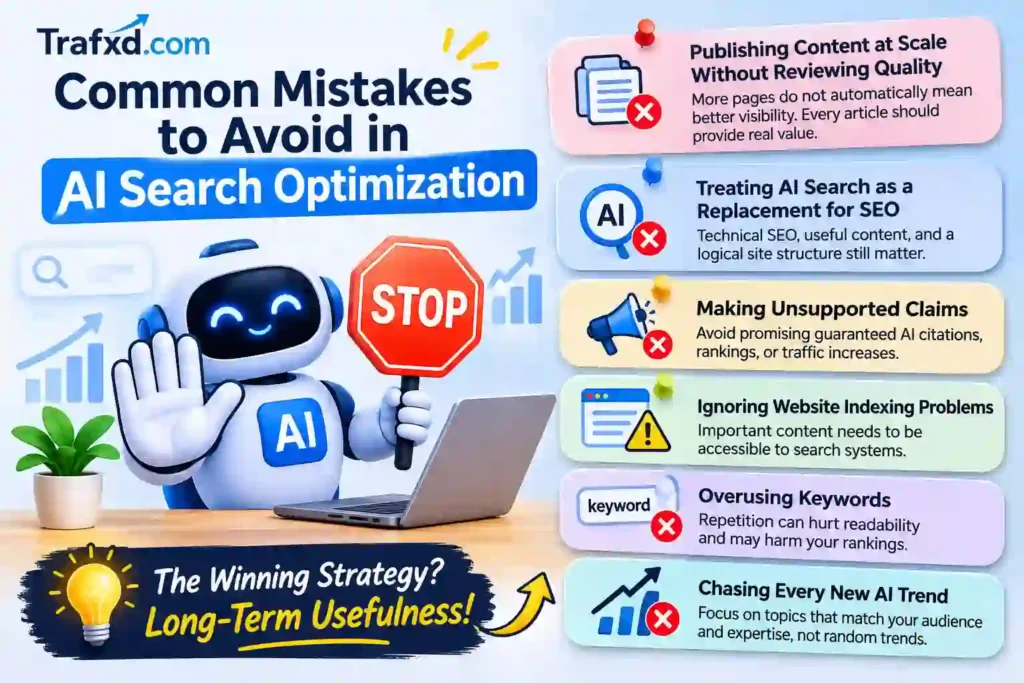
The strongest strategy is built around long-term usefulness, not short-term tricks.
Conclusion: Build a Website That Deserves to Be Discovered
Learning how to optimize your website for AI search engines is not about finding a secret formula to appear in every AI-generated answer. It is about creating a website that provides useful information, demonstrates credibility, and makes its content accessible to search systems.
Start with the fundamentals: publish genuinely helpful articles, improve your technical SEO, organize related content with internal links, and support your recommendations with reliable information and real examples. Then measure your progress and refine your approach as search technology evolves.
If you run a business website, a blog, or a growing online brand, you do not need to implement everything at once. Begin with one important page, identify its weaknesses, and make meaningful improvements.
Want to improve your website’s SEO and search visibility? At Trafxd.com, we share practical guidance on SEO, WordPress, AI, and digital growth to help website owners make smarter decisions. Explore our related guides, put these strategies into practice, and take the next step toward building a website that earns visitors’ trust.
Frequently Asked Questions
1. What is AI search engine optimization?
AI search engine optimization is the process of improving website content, structure, and technical performance so AI-powered search platforms can understand, discover, and potentially reference your information in their answers.
2. How can I make my website appear in AI search results?
Publish helpful, accurate, and well-structured content. Use clear headings, answer common questions, improve technical SEO, and make sure search engines can crawl and index your important pages.
3. Is traditional SEO still important for AI search engines?
Yes. Traditional SEO remains important because AI search platforms still rely on accessible, relevant, and trustworthy web content. Good technical SEO, quality backlinks, and useful content can support overall search visibility.
4. Does AI-generated content help websites rank in AI search results?
AI-generated content can be useful when it provides accurate, original, and valuable information. However, publishing large amounts of unreviewed or repetitive content does not guarantee better rankings or AI citations.
5. How long does it take to optimize a website for AI search engines?
There is no fixed timeline. Results depend on your website’s technical health, content quality, competition, and indexing. Focus on consistent improvements and monitor your search performance over time.