What Is Blockchain? A Complete Beginner’s Guide
Blockchain is transforming the digital world by changing how people and businesses store, verify, and share information. From Bitcoin and cryptocurrencies to smart contracts, Web3, digital payments, and supply chains, blockchain technology work in simple terms, can be understood as a secure way to record digital information across a network of computers. Unlike traditional databases that depend on a central authority, blockchain can distribute records across multiple participants, making data more transparent and difficult to alter without detection.
But how does blockchain actually work? The answer involves blocks, transactions, cryptography, nodes, and consensus mechanisms working together to maintain a trusted digital record. As blockchain adoption continues to grow across finance, technology, healthcare, gaming, and business, understanding its fundamentals has become increasingly valuable.
In this complete beginner guide, you’ll discover how blockchain works, its key features, benefits, real-world applications, security, smart contracts, and future potential—all explained in simple terms.
What Is Blockchain?
Blockchain is a type of distributed digital ledger that records information in groups called blocks. Blockchain connects these blocks in a chronological chain, which is why the technology is called a “blockchain.”
Think of blockchain as a digital notebook that many people share. Whenever new participants add new information, the network participants verify it according to the network’s rules. Once the network records the information, changing an old record becomes extremely difficult because the network maintains connected records.
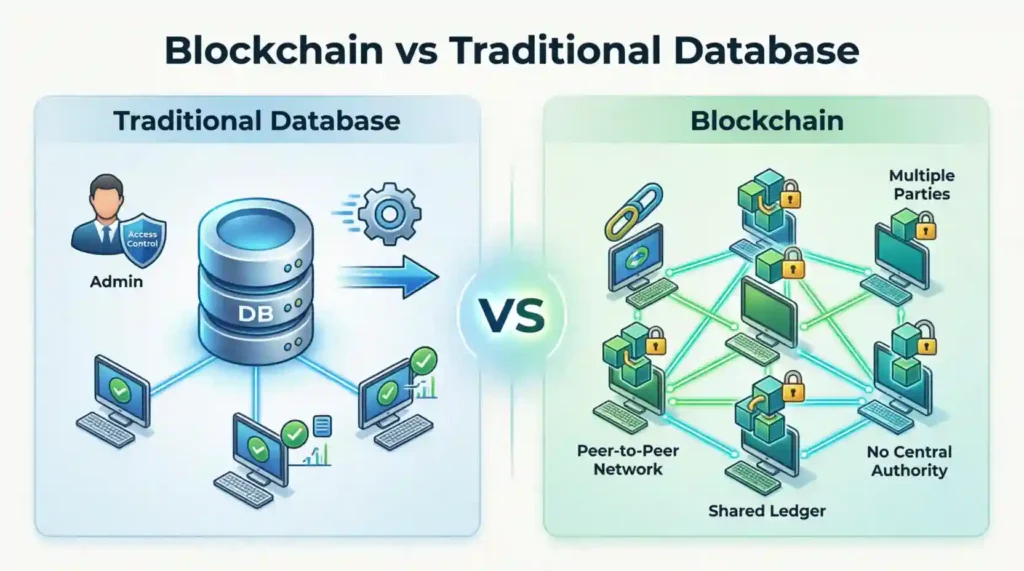
Unlike a traditional database that one organization controls, many blockchain networks are decentralized, meaning multiple computers or participants share the responsibility for verifying transactions and maintaining the network.
This basic concept is what makes blockchain an important part of emerging technology.
How Does Blockchain Technology Work in Simple Terms?
Understanding how blockchain works is easier when we break the process into several basic steps.
1. The Request The Transaction
First, someone initiates a transaction.
For example, imagine Alice wants to send a digital asset to Bob. The transaction contains information about what is being transferred and where it should go.
2. The Network Broadcast the Transaction
The transaction is sent to computers participating in the blockchain network. These computers are commonly called nodes.
Nodes communicate with each other and help maintain the blockchain network.
3. The Transaction Is Verified
Before the transaction is added to the blockchain, the network needs to determine whether it follows the rules. Depending on the blockchain, this process can involve different consensus mechanisms.
For example, some networks use Proof of Work, while others use Proof of Stake.
4. The Network Adds Verified Transactions to a Block
Once transactions are verified, they can be grouped together into a block.
A block may contain multiple transactions along with other information needed by the blockchain protocol.
5. The Network Adds the Block to the Chain
The new block is connected to the previous blocks. This creates a chronological chain of records.
Because blocks are cryptographically connected, changing information in an earlier block can affect the relationships between later blocks.
6. The Network Updates Its Records
Participating computers update their records according to the blockchain’s rules. The result is a shared digital record maintained across the network.
This is the basic process behind how blockchain transactions work.
What Is Inside a Blockchain Block?
A blockchain block can contain several types of information.
Depending on the blockchain, a block may include:
- Transaction information
- A timestamp
- A reference to the previous block
- A cryptographic hash
- Network-specific data
- Validation information
A hash is particularly important. A hash can be thought of as a unique digital fingerprint created from data. If the underlying data changes, the resulting hash can also change.
Because blocks are connected using cryptographic information, unauthorized changes can become easier for the network to detect.
What Are Blockchain Nodes?
A node is a computer or device that participates in a blockchain network. Nodes can have different responsibilities depending on the blockchain.
Some nodes may store blockchain data, verify transactions, communicate with other nodes, or participate in consensus.
The use of many independent nodes is one reason blockchain can operate without relying entirely on a single central server.
For someone learning blockchain for beginners, nodes are an important concept because they help explain how decentralized networks function.
What Is Decentralization?
Decentralization is one of the most important ideas associated with blockchain. In a traditional system, information may be controlled by a central organization.
For example, a bank maintains its own database to keep track of customers and transactions.
In a decentralized blockchain network, records can be distributed across many participants. This does not mean that every blockchain is completely decentralized. Different blockchain networks can have different levels of decentralization.
However, reducing dependence on a single authority is one of the main ideas behind blockchain technology.
A Brief History of Blockchain
The concept of blockchain did not appear overnight.
In the early days of the internet and computer science, researchers explored ways to create secure digital records and timestamps. In 1991, Stuart Haber and W. Scott Stornetta proposed a system for securely timestamping digital documents.
The technology received worldwide attention in 2008 when an individual or group using the name Satoshi Nakamoto introduced the Bitcoin system.
Bitcoin launched in 2009 and used a blockchain to maintain a decentralized record of transactions.
Over time, developers began exploring blockchain beyond digital currencies.
This led to new applications involving smart contracts, decentralized applications, supply chains, identity systems, financial services, and other areas.
Today, blockchain is considered an important area of emerging technology.
Key Features of Blockchain
Understanding the main blockchain feature can help beginners understand why businesses and developers are interested in the technology.
1. Decentralization
Blockchain networks can distribute data and verification across multiple participants instead of relying on one central database.
2. Transparency
Many public blockchains allow participants to view transaction information. However, the amount of information visible depends on the particular blockchain.
3. Immutability
The blockchain systems are designed to make records difficult to alter after they’re confirmed and added to the chain.
Immutability does not mean that blockchain data is magically impossible to change under every circumstance. Rather, blockchain systems use cryptography and consensus rules to make unauthorized modification difficult.
4. Security
Cryptographic techniques help protect blockchain transactions and connect blocks together.
However, blockchain security also depends on wallets, private keys, applications, smart contracts, and the overall network design.
5. Traceability
Blockchain can provide a chronological record of transactions, which can be useful for tracking assets and information.
What Are the Benefits of Blockchain?
There are several potential benefits of blockchain technology.
1. Reduced Dependence on Intermediaries
Some blockchain applications can allow users to interact directly without relying on traditional intermediaries for every transaction.
2. Improved Transparency
Public blockchain networks can make transaction records easier to verify.
3. Better Traceability
Businesses can potentially use blockchain to track products and transactions through different stages of a process.
4. Data Integrity
Cryptographic mechanisms can make unauthorized changes to records easier to detect.
5. Automation
Blockchain-based smart contracts can automatically execute predefined actions when specified conditions are met.
6. Global Accessibility
Some blockchain networks operate globally and can be accessed through internet-connected systems, although access and regulation vary by application and location.
What Are Blockchain Applications?
Blockchain is no longer limited to cryptocurrency.
Here are some important blockchain applications and use cases.
Cryptocurrency
Cryptocurrency is the most famous blockchain use case.
Bitcoin and many other digital currencies use blockchain technology to record transactions.
Financial Services
Financial institutions and fintech companies are exploring blockchain for areas such as settlement, payments, tokenization, and record management.
Supply Chain Management
Blockchain can help organizations create records showing where products came from and how they moved through a supply chain.
For example, companies could potentially use blockchain to track food products from producers to retailers.
Healthcare
Blockchain has been explored for secure data sharing, identity management, and medical record systems.
However, healthcare applications require strong privacy and regulatory protections.
Digital Identity
Blockchain technology can potentially support new approaches to digital identity and credential management.
Real Estate
Blockchain can be used in experiments involving property records, digital ownership, and tokenization.
Gaming
Blockchain has also been used in gaming applications involving digital assets and ownership systems.
Intellectual Property
Blockchain may help create verifiable records related to digital assets and ownership.
These examples demonstrate that blockchain use cases can extend far beyond cryptocurrency.
What Are Smart Contracts?
A blockchain network stores and executes a smart contract.
Instead of relying entirely on a person or organization to perform a predefined action, a smart contract automatically executes programmed instructions when the required conditions are met.
For example, imagine a digital agreement that says:
“If condition A happens, perform action B.”
A smart contract can be designed to follow those rules automatically. Many blockchain ecosystems and decentralized applications use smart contracts.
Public vs Private Blockchain
Not every blockchain works in exactly the same way.
| Feature | Public Blockchain | Private Blockchain |
| Access | Generally open to anyone who follows the network roles | Restricted to approved users or organizations |
| Control | Decentralized; no single organization usually controls the network | Controlled by a specific organization or group |
| Participation | Anyone may participate, depending on the network | Only authorized participants can join |
| Transparency | Transactions are generally visible to network participants | Information can be limited to authorized users |
| Speed | May be slower because many participants validate transactions | Often faster due to fewer authorized participants |
| Examples | Bitcoin, Ethereum | Enterprise or permissioned blockchain systems |
| Best for | Open networks, cryptocurrencies, and decentralized applications | Businesses requiring privacy, control, and permission-based access |
| Main Avantages | Greater decentralization and openness | Greater control, privacy, and efficiency |
Is Blockchain Secure?
Blockchain can provide strong security mechanisms, but it is not automatically secure in every situation.
The security of a blockchain system can depend on several factors, including:
- Consensus mechanism
- Network design
- Cryptographic security
- Private-key management
- Smart contract code
- Wallet security
- User behavior
- Application design
For example, if someone loses control of a private key, the blockchain itself may not be able to recover the associated assets.
Therefore, blockchain security involves much more than simply putting information on a blockchain.
How to Learn Blockchain
If you are wondering how to learn blockchain, you do not need to become an expert immediately.
Start with the fundamentals.
Step 1: Learn Basic Blockchain Concepts
Understand blocks, hashes, nodes, transactions, wallets, decentralization, and consensus.
Step 2: Understand Cryptocurrency
Learn how Bitcoin and other cryptocurrencies use blockchain technology.
Step 3: Learn Smart Contracts
After understanding the basics, explore how smart contracts work.
Step 4: Learn Programming
If you want to become a developer, learning programming is essential.
Languages and technologies can vary depending on the blockchain ecosystem you choose.
Step 5: Explore Blockchain Development
Build small projects to understand how blockchain applications work.
Step 6: Follow a Blockchain Developer Roadmap
A blockchain developer roadmap can help you move from basic programming to blockchain architecture, smart contracts, decentralized applications, testing, security, and deployment.
The key is to learn gradually instead of trying to understand everything at once.
Blockchain vs Traditional Database
A traditional database and a blockchain can both store information, but they are designed for different purposes.
What Is the Future of Blockchain?
The future of blockchain will likely depend on practical applications rather than hype alone.
Developers and businesses are exploring blockchain for payments, digital assets, financial infrastructure, supply chains, identity, data sharing, and automated agreements.
At the same time, blockchain faces challenges such as scalability, energy consumption for some consensus mechanisms, regulatory uncertainty, usability, security risks, and integration with existing systems.
As technology improves, some blockchain applications may become more practical and easier for ordinary users to access.
The future may not involve blockchain replacing every existing technology. Instead, blockchain could become one component of a broader digital technology ecosystem.
Conclusion
Understanding what blockchain is does not have to be difficult. In simple terms, blockchain is a technology that allows digital information to be recorded, verified, and shared across a network without relying on one central authority. Its unique structure helps create transparency, security, and trust between participants.
From cryptocurrency and smart contracts to supply chain management, digital identity, healthcare, and financial services, blockchain technology is opening the door to new ways of managing digital records and transactions. At the same time, it has limitations, including scalability, energy consumption in some networks, regulatory uncertainty, and technical complexity.
For beginners, the best approach is to start with the basics. Learn how transactions are verified, how blocks are connected, and why decentralization is important. Once these concepts become clear, more advanced blockchain applications become much easier to understand.
Blockchain is more than just cryptocurrency. It represents a new approach to digital trust, ownership, and information sharing. As technology continues to evolve, blockchain may play an important role in shaping the future of the digital world.
Frequently Asked Questions (FAQs)
1. Is blockchain the same as cryptocurrency?
No. Cryptocurrency is one application of blockchain technology. People use Blockchain for many other purposes.
2. Is blockchain completely decentralized?
Not necessarily. Different blockchain networks have different governance structures and levels of decentralization.
3. Can Users change blockchain data?
Blockchain systems are designed to make confirmed records difficult to alter. However, the exact properties depend on the blockchain’s design and governance.
4. Is blockchain useful for businesses?
It can be useful in situations where multiple parties need shared records, traceability, automation, or reduced dependence on a central intermediary.
5. How can beginners learn blockchain?
Start with basic concepts such as blocks, transactions, hashes, nodes, wallets, consensus, and smart contracts. Then move into programming and practical projects if you want to become a developer.