What Is Web3? A Complete Beginner’s Guide
Imagine an internet where you can own a digital asset without depending entirely on one company, send value directly to another person across borders, or use an application without creating a traditional username and password.
That idea is at the heart of the growing conversation around Web3.
The internet has already gone through major changes. The first generation mainly allowed people to read information. The modern web lets people read, create, share, shop, communicate, and build online communities. The next stage explores a different approach based on blockchain networks, digital ownership, decentralized applications, and programmable transactions.
If you are searching for what Web3 technology is for beginners, think of it as a broad vision for an internet where users can have greater control over certain digital assets and interactions.
However, this does not mean that Web3 has already replaced today’s internet. It is still developing, and its technologies come with both opportunities and limitations.
Let’s break down the concept from the ground up.
What Is Web3 Technology for Beginners?
Web3 is a broad term for a proposed model of the internet that emphasizes decentralization, digital ownership, blockchain technology, and user participation.
Traditional websites and applications usually depend on centralized companies. These companies may control the servers, databases, accounts, and rules that make their platforms work.
Blockchain-based systems take a different approach. Instead of storing everything in one company’s private database, some information and transactions can be recorded on distributed networks.
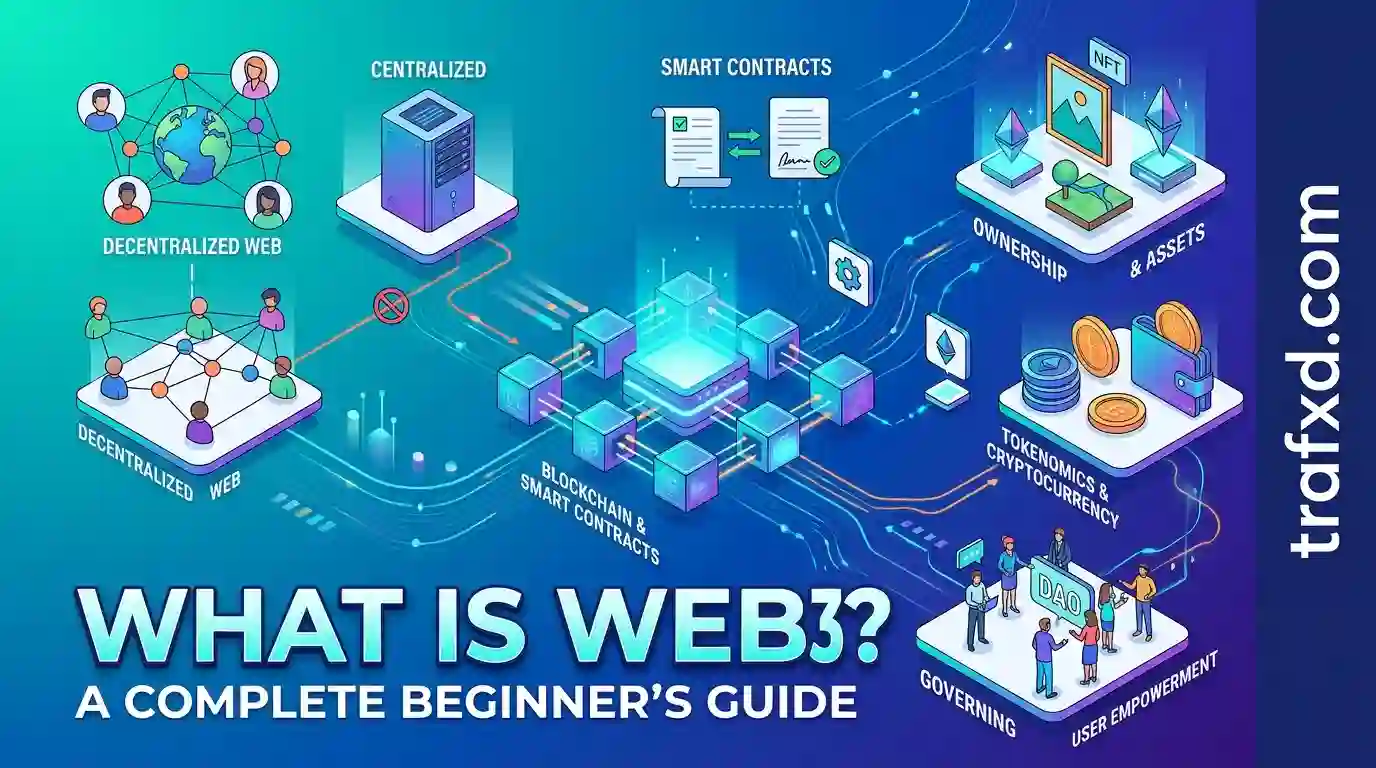
In simple terms, the main ideas include:
- Blockchain: A distributed system for recording information and transactions.
- Digital wallets: Tools that allow users to manage blockchain accounts and assets.
- Smart contracts: Programs that automatically execute predefined rules.
- Cryptocurrencies: Digital assets used for payments, fees, or other functions.
- NFTs: Unique blockchain-based tokens that can represent digital or physical assets.
- dApps: Applications that use decentralized infrastructure.
- Digital ownership: The ability to control certain blockchain-based assets directly.
One important point is that Web3 does not have one universally accepted definition. It is better understood as a collection of technologies and ideas rather than one specific product.
How the Internet Evolved: Web1, Web2, and Web3
To understand the current discussion, it helps to look at how the internet developed.
Web1 — The Read-Only Web
The early internet was largely made up of static websites.
Visitors could:
- Read articles
- View information
- Browse simple pages
- Follow links between websites
There was limited interaction compared with today’s online experience.
Web2 — The Social and Interactive Web
Web2 transformed the internet into a highly interactive environment.
People could:
- Create social media profiles
- Upload videos and photographs
- Publish blogs
- Comment on content
- Buy products online
- Use cloud applications
- Communicate instantly
Platforms became extremely powerful because they could collect data, connect users, and provide services at enormous scale.
However, this model also means that many important digital experiences depend on centralized organizations.
Web3 — The Ownership-Oriented Web
The Web3 vision introduces another possibility: allowing users to interact with decentralized networks and directly control certain digital assets.
Instead of everything being controlled by a platform, some functions can be handled by blockchain networks and smart contracts.
The three stages are often simplified as:
Web1 → Read
Web2 → Read + Write
Web3 → Read + Write + Own
This is a useful way to understand the concept, although real-world technologies are more complicated than this simple comparison suggests.
How Does This New Internet Model Work?
There isn’t one single technology powering every project. Instead, several components work together.
1. Blockchain Networks
Blockchains provide a shared record of transactions and other information.
Rather than depending entirely on one central database, copies of blockchain data can be maintained across participating computers.
2. Digital Wallets
A wallet allows users to interact with blockchain networks.
Depending on the wallet, it may allow people to:
- Store digital assets
- Send and receive cryptocurrency
- Connect to decentralized applications
- Approve transactions
- Manage blockchain accounts
A wallet is not simply a digital bank account. Users are often responsible for protecting their private keys or recovery information.
3. Smart Contracts
Smart contracts are programs deployed on blockchain networks.
They can automatically execute instructions according to their programmed rules.
For example, a smart contract might:
- Transfer tokens
- Record ownership
- Process an exchange
- Manage voting rules
- Control access to a digital service
4. Decentralized Applications
Users can interact with blockchain-based applications through websites or other interfaces.
The visible interface might look familiar, but some of the application’s logic can operate through smart contracts.
Key Features of Web3
Several characteristics frequently appear in discussions about this technology.
Decentralization
Control can be distributed across a network instead of being concentrated in one organization.
Digital Ownership
Blockchain tokens can represent ownership or control of specific digital assets.
Transparency
Public blockchain networks can make transaction records independently verifiable.
Programmability
Smart contracts allow developers to create applications that follow predefined rules.
Peer-to-Peer Transactions
Blockchain networks can allow users to transfer digital assets directly between blockchain addresses without relying entirely on traditional intermediaries.
Global Accessibility
Many public blockchain networks are accessible from different parts of the world, although laws, infrastructure, internet access, and service availability vary by location.
Blockchain and Its Role in the New Internet
Blockchain is one of the most important technologies associated with this movement.
Think of a blockchain as a shared digital record.
Instead of one organization maintaining the only copy, participating computers help maintain the network.
A blockchain can record:
- Transactions
- Token balances
- Digital ownership
- Smart-contract activity
- Other types of network data
Ethereum is one well-known blockchain platform that supports smart contracts and decentralized applications.
Blockchain technology is useful because participants can verify records without necessarily relying on a single centralized database.
However, blockchain isn’t automatically the best solution for every problem. Traditional databases can be faster, cheaper, and more practical for many applications.
Understanding Decentralization
Decentralization sounds complicated, but the basic idea is simple.
Imagine a traditional service where one company controls everything. Now imagine a network where many independent participants help maintain the system.
That second model is closer to decentralization.
Potential advantages include:
- Reduced dependence on a single organization
- Greater transparency
- Open participation
- Resistance to certain types of centralized control
But decentralization exists on a spectrum.
A project can use blockchain technology while still depending on centralized:
- Companies
- Websites
- Hosting services
- Development teams
- Infrastructure providers
Therefore, it is important to examine how each project actually works rather than assuming that every project described as decentralized is fully decentralized.
How Smart Contracts Work
Smart contracts are one of the most interesting parts of blockchain technology.
Imagine a vending machine.
You insert the required payment, select a product, and the machine follows its programmed rules to deliver the item.
A smart contract works in a somewhat similar way:
Input → Programmed rules → Automatic result
For example:
If the required conditions are satisfied, the contract performs the programmed transaction.
Smart contracts can reduce the need for manual processing in certain situations.
They are used in areas such as:
- Decentralized finance
- NFT marketplaces
- Blockchain gaming
- Token systems
- Governance
- Digital asset management
But there is an important warning: smart contracts can contain bugs. Once deployed, changing their behavior may be difficult or impossible depending on their design.
Cryptocurrencies and Digital Transactions
Cryptocurrency is closely connected with many blockchain ecosystems.
Digital currencies can serve several purposes:
- Paying transaction fees
- Sending value
- Supporting decentralized applications
- Participating in certain governance systems
- Representing digital assets
For example, Ether (ETH) is the native cryptocurrency of Ethereum and is used to pay for transactions and computational activity on the network.
However, Web3 and cryptocurrency are not the same thing.
Web3 is a broader concept that can include:
Blockchain + smart contracts + digital identity + dApps + tokenization + decentralized infrastructure
Cryptocurrency is only one part of that larger ecosystem.
NFTs and Digital Ownership
NFT stands for non-fungible token.
Unlike interchangeable cryptocurrency units, NFTs are designed to represent unique tokens.
They have been used for:
- Digital artwork
- Collectibles
- Gaming items
- Memberships
- Tickets
- Digital certificates
- Virtual assets
But there is an important distinction between owning an NFT and owning copyright.
Buying an NFT does not automatically give the buyer copyright over the artwork or other content associated with that token. The rights depend on the project’s terms.
This is one of the most important concepts beginners should understand before buying or collecting digital assets.
Decentralized Applications (dApps)
A decentralized application, often called a dApp, is an application that uses decentralized networks or blockchain-based smart contracts.
A dApp may look like a normal website from the user’s perspective.
Behind the interface, however, it may interact with blockchain networks instead of relying entirely on a traditional centralized server.
Common dApp categories include:
- Finance
- Gaming
- Marketplaces
- Social networks
- Collectibles
- Governance
- Identity
- Investment-related applications
The technology allows developers to create applications with rules that can be executed through blockchain infrastructure.
Web3 vs Web2: Key Differences
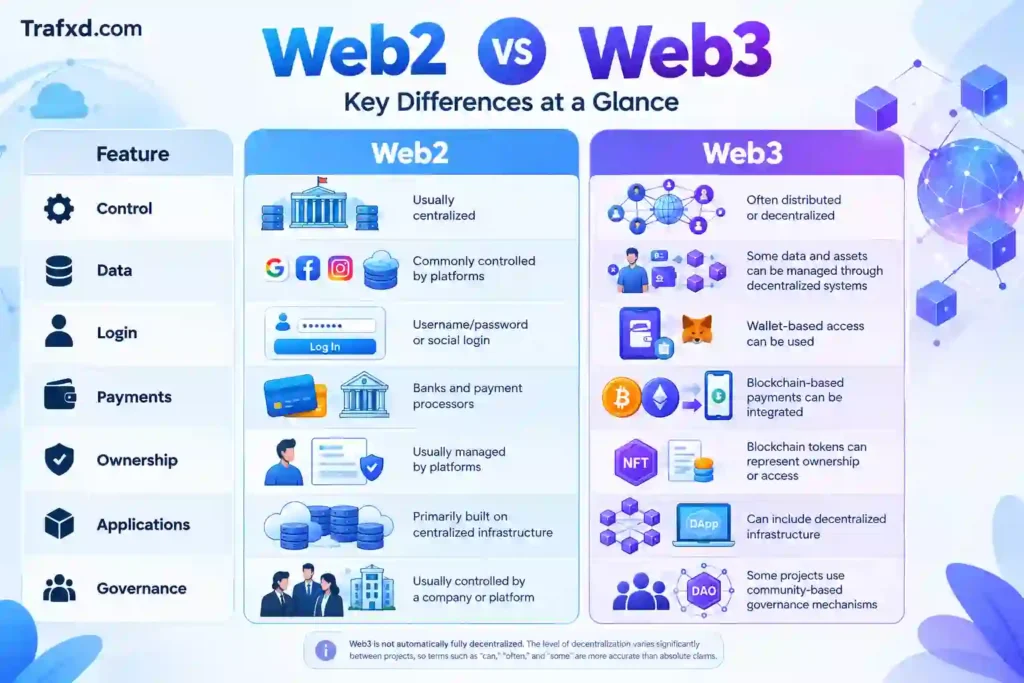
This is a simplified comparison. Many modern applications combine centralized and decentralized components.
Real-World Uses and Applications
The technology is being explored in several industries.
Finance
Decentralized finance, or DeFi, uses blockchain applications for activities such as trading, lending, and other financial services.
Gaming
Blockchain games can use tokens and NFTs to represent certain digital assets.
Digital Art
Artists can use NFTs to create blockchain-based records associated with digital works.
Social Media
Some projects are exploring social networks where users can have greater control over identity, content, or digital assets.
Supply Chains
Blockchain systems can potentially provide shared records that help participants track products and transactions.
Digital Identity
Blockchain-based identity systems are being explored as a way to give people more control over certain digital credentials.
Community Governance
Some blockchain projects allow participants to vote on proposals through decentralized governance mechanisms.
Potential Benefits
The technology offers several possibilities.
Greater Digital Ownership
Users can directly control certain blockchain-based assets instead of depending entirely on a platform.
Open Participation
Some public blockchain networks allow people to participate without traditional platform approval.
Transparent Records
Transactions recorded on public blockchains can be independently verified.
Automated Processes
Smart contracts can execute predefined actions without manual intervention.
Global Transactions
Blockchain networks can support digital asset transfers across borders, although regulations and practical limitations vary.
New Business Models
Tokenization and decentralized applications may create new ways to build communities, services, marketplaces, and digital products.
Challenges and Limitations
Despite its potential, there are plenty of challenges.
Complexity
Wallets, blockchain addresses, network fees, and transactions can be confusing for newcomers.
Security
Users can face:
- Phishing attacks
- Fake websites
- Malicious smart contracts
- Stolen private keys
- Fraudulent projects
- Wallet scams
Scalability
Some blockchain networks have faced limitations involving transaction speed, network congestion, and fees.
Regulation
Governments around the world are developing different approaches to cryptocurrencies, digital assets, and blockchain applications.
User Experience
Traditional applications are often easier for beginners because users don’t have to manage private keys or understand blockchain transactions.
Decentralization Questions
Not every project is equally decentralized. Some still depend heavily on companies or centralized infrastructure.
Market Volatility
Digital assets can experience significant price fluctuations, which creates financial risk for users.
Is This Technology Secure?
Blockchain networks can provide strong security properties, but that does not mean every application built on them is safe.
A user can lose assets because of:
- A compromised wallet
- A stolen recovery phrase
- A malicious transaction
- A smart-contract vulnerability
- A phishing website
- A fraudulent project
Good security habits are therefore essential.
Before connecting a wallet or approving a transaction:
- Check the website address carefully.
- Never share your private key or recovery phrase.
- Understand what you are signing.
- Research unfamiliar applications.
- Be suspicious of guaranteed returns.
- Avoid clicking unknown wallet links.
In decentralized systems, users often have greater responsibility for protecting their own assets.
What Could the Future of the Internet Look Like?
The future of this technology is still uncertain.
Some Web3 concepts may become widely adopted, while others may disappear or evolve into different forms.
Possible areas of continued development include:
- Digital identity
- Tokenization
- Blockchain payments
- Decentralized finance
- Digital ownership
- Blockchain gaming
- Decentralized social platforms
- Smart-contract applications
It is also possible that future internet services will combine centralized and decentralized technologies rather than choosing only one model.
The success of these ideas will depend on whether developers can make them secure, affordable, scalable, simple, and useful for ordinary users.
Conclusion
The easiest way to understand what Web3 technology is for beginners is to think of it as a broad vision for an internet that gives greater importance to decentralization, digital ownership, and programmable online interactions.
Blockchain networks provide the infrastructure for many projects, while smart contracts can automate rules and transactions. Cryptocurrencies, NFTs, wallets, and dApps add different capabilities to this ecosystem.
At the same time, the technology is not perfect. Security risks, complicated user experiences, scalability issues, regulation, and questions about actual decentralization remain important challenges.
Rather than viewing this technology as a guaranteed replacement for the current internet, it is more useful to see it as an evolving area of technology. Its long-term impact will depend on whether developers can turn its ideas into practical tools that are secure, useful, accessible, and valuable for everyday users.
Frequently Asked Questions
Is Web3 the same as cryptocurrency?
No. Cryptocurrency is one component of some Web3 ecosystems. The broader concept includes blockchain networks, smart contracts, dApps, digital ownership, identity systems, and other technologies.
Do I need cryptocurrency to use these applications?
Not necessarily. Some applications require cryptocurrency for transactions or network fees, while others hide these technical processes behind a simpler user interface.
Is everything decentralized?
No. Different projects have different levels of decentralization. Some combine blockchain technology with centralized companies and infrastructure.
Is Web3 replacing Web2?
Not currently. Both models continue to exist, and many applications use a combination of centralized and decentralized technologies.
Is Web3 suitable for beginners?
Anyone can learn the basic concepts. Beginners should start with blockchain fundamentals, wallets, smart contracts, and security practices before interacting with applications involving valuable assets.
Can Web3 be used without NFTs?
Yes. NFTs are only one part of the broader ecosystem. Blockchain applications can also involve payments, finance, identity, governance, and other functions.