Content Marketing Trends 2027: Strategies That Will Drive Results
Content marketing is moving beyond traditional search and basic blog posts. In 2027, brands will compete for attention across Search Engine Optimization, Social Media Marketing, video, AI-powered search, newsletters, communities, and affiliate marketing. Audiences are no longer impressed by content that simply fills a page—they want useful ideas, real experiences, quick answers, and trustworthy information.
The biggest content marketing trends in 2027 will include AI-assisted content creation, hyper-personalization, short-form video, user-generated content, content repurposing, and first-hand expertise. But technology is only part of the game. Successful brands will combine smart tools with authentic storytelling and human insight.
In this guide, we’ll explore powerful content marketing trends in 2027 to help businesses attract attention, build trust, increase engagement, and turn content into measurable growth.
Content Strategy Trends in 2027: What Businesses Should Prepare For
The major content marketing trends in 2027 will not exist in isolation.
- AI will influence content creation.
- Personalization will influence audience engagement.
- Video will influence distribution.
- Repurposing will influence productivity.
- User-generated content will influence trust.
- Analytics will influence decision-making.
Together, these developments will create a more connected approach to digital communication.
Businesses should therefore avoid chasing every new tool or platform. Instead, they should create a strong foundation and then use emerging technology to improve it.
1. Quality Will Matter More Than Quantity
The internet already contains enormous amounts of information. Adding another generic article to an overcrowded topic may not provide much value.
Before publishing, ask:
“Why should someone choose this article instead of the other 100 articles about the same subject?”
Your answer might be:
- original research
- better examples
- expert experience
- clearer explanations
- unique data
- stronger visuals
- practical templates
- real case studies
- better organization
That difference is what gives content a reason to exist.
2. Content Distribution Will Be Just as Important as Content Creation
Creating excellent content is only half of the job. You also need to get it in front of the right audience.
Distribution can include:
- search engines
- email newsletters
- social media
- communities
- video platforms
- industry publications
- partnerships
- podcasts
- online events
A useful article that nobody discovers cannot achieve its full potential. Therefore, businesses should plan distribution before publishing.
For every major article, decide:
- Where will this content be promoted?
- Which audience will see it?
- Which format will work best on each platform?
- How can the article be repurposed?
These questions can dramatically improve the value of existing content.
How Small Businesses Can Use These Trends
Large companies may have dedicated content teams, designers, video editors, SEO specialists, and data analysts. Small businesses may not have those resources.
Fortunately, they do not need to implement every trend at once. A small business can start with a simple system.
- Choose one clearly defined audience.
- Identify ten important questions that the audience asks.
- Create detailed resources that answer those questions.
- Turn each resource into several formats.
- Distribute the content across the platforms where the audience already spends time.
- Measure which topics generate the strongest response.
- Create more content around the subjects that perform well.
This approach is more sustainable than trying to publish something new every day.
10 Content Marketing Strategies That Will Drive Results in 2027
To summarize the most important opportunities, businesses should focus on these ten areas:
- Use AI strategically rather than relying on completely automated content.
- Build AI-powered workflows that improve research, planning, and personalization.
- Create personalized experiences for different audience segments.
- Invest in video to communicate information in engaging formats.
- Repurpose strong content across multiple channels.
- Add original experience and research to differentiate your work.
- Encourage customer-created content to build trust and social proof.
- Create a measurable strategy connected to specific business goals.
- Optimize for conversational discovery by answering real audience questions.
- Measure business outcomes rather than focusing only on publishing volume.
These approaches can work together to create a sustainable digital presence.
How businesses can use AI effectively
A useful workflow is to divide the content process between technology and people.
For example:
- Use AI to brainstorm potential topics.
- Research the audience’s actual problems.
- Identify questions that deserve detailed answers.
- Create an initial outline.
- Add original insights and real-world examples.
- Fact-check important information.
- Edit the content for accuracy and readability.
- Add your unique brand voice.
- Optimize the article for search intent.
- Review the final piece before publishing.
This approach makes AI a tool rather than a replacement for expertise. The future will belong to businesses that can produce content efficiently while still maintaining originality and credibility.
1. AI-Powered Content Creation Will Become More Strategic
Artificial intelligence has already changed the way marketers research topics, generate ideas, analyze data, create outlines, and produce content. In 2027, AI is likely to become even more integrated into everyday marketing workflows.
However, the biggest opportunity will not simply be using AI to generate thousands of articles. Instead, marketers will use AI as a productivity and research assistant while keeping human expertise at the center of their content.
This is one of the most important AI content creation trends to understand.
AI can help marketers identify frequently asked questions, discover content gaps, analyze audience behavior, generate initial ideas, summarize research, and organize information. These capabilities can save considerable time.
Nevertheless, automatically publishing generic AI-generated articles can create problems. If hundreds of websites publish similar information using the same tools, readers have little reason to choose one article over another.
The businesses that stand out will add human experience, original examples, expert opinions, case studies, personal observations, data, and practical recommendations
2. AI-Powered Content Strategies Will Focus on Audience Intent
AI is not only changing how content is produced. It is also changing how people discover information.
As search behavior is becoming more conversational. Instead of typing a few short keywords, users increasingly ask detailed questions and expect direct answers. This means businesses need to understand the underlying purpose behind a search rather than focusing only on individual keywords. Content marketing trends in 2027 are increasingly focused on understanding audience intent.
An AI-powered content strategy should therefore begin with audience needs.
Ask questions such as:
- What problem is the customer trying to solve?
- What information do they need before purchasing?
- What questions do beginners frequently ask?
- What concerns stop people from buying?
- Which topics require expert explanation?
- What information would make the decision easier?
Once these questions are understood, marketers can create content that answers the entire journey rather than targeting isolated search terms.
For example:
A software company should not publish only an article titled “Best Project Management Software.” It could also publish guides about choosing software, comparing features, managing remote teams, improving productivity, calculating costs, onboarding employees, and avoiding common implementation mistakes.
This creates a deeper information ecosystem around the audience’s needs.
Personalization Will Become More Important
People are exposed to enormous amounts of information every day. As a result, generic messages are becoming easier to ignore. Personalization allows businesses to make their content more relevant to specific audiences.
For example, a marketing agency might create different resources for:
- startups
- freelancers
- small businesses
- e-commerce stores
- established companies
The core subject may be similar, but the examples, problems, budgets, and recommendations may differ.
This is why personalized content strategies will become increasingly important. Personalization does not always require complicated technology. Even simple audience segmentation can make content more useful.
For example:
Instead of publishing one broad guide about email marketing, a business could create separate resources for beginners, e-commerce businesses, SaaS companies, and local businesses.
The more accurately a piece of content reflects the reader’s situation, the more likely that reader is to find it valuable.
Personalization should not feel intrusive
There is an important difference between useful personalization and excessive personalization. Businesses should use customer information responsibly. The goal should be to improve the experience rather than make users uncomfortable.
Relevant recommendations, audience-specific examples, customized newsletters, and useful resources can improve engagement without becoming invasive.
Video Will Continue to Dominate Attention
Written articles remain valuable, but video has become one of the most important ways people consume information.
Short-form videos, tutorials, interviews, demonstrations, webinars, product explainers, and educational videos can communicate information quickly and visually.
This makes the content marketing trends in 2027 an important area for marketers to watch.
A business does not necessarily need expensive equipment to begin. A smartphone, good lighting, clear audio, and useful information can be enough to create valuable videos.
The key is not production complexity. The key is usefulness.
For example, a technology company could create:
- software tutorials
- product demonstrations
- troubleshooting videos
- comparison videos
- expert interviews
- customer stories
- short educational clips
A financial website could create simple educational videos explaining complicated concepts. A fitness business could demonstrate exercises. A cooking brand could publish recipe videos.
The possibilities depend on the audience.
Combine video with written content
Video and blogging should not be treated as competing formats. A single detailed article can become a video, short-form clips, an email newsletter, social media posts, an infographic, and a podcast discussion.
This leads directly to another important trend: content repurposing.
Content Repurposing Will Help Businesses Do More With Less
Creating high-quality content requires time and resources. One of the smartest ways to improve efficiency is to reuse valuable information in multiple formats. Content repurposing strategies allow marketers to turn one strong piece of content into many smaller assets.
Imagine you publish a comprehensive guide about improving online visibility.
That single guide could become:
- A YouTube video
- five short videos
- an Instagram carousel
- Several LinkedIn posts
- an email newsletter
- an infographic
- A podcast discussion
- a checklist
- a presentation
- Several social media posts
The original research does not need to be repeated every time.
Originality and First-Hand Experience Will Become Competitive Advantages
As AI makes content creation easier, original experiences will become more valuable. Imagine two articles discussing the same software:
- The article summarizes information found on other websites.
- The article explains how the writer actually used the software, describes what worked, discusses limitations, provides screenshots, and explains mistakes they encountered.
The second article offers something more difficult to replicate.
This is why businesses should incorporate:
- original research
- customer experiences
- case studies
- expert interviews
- surveys
- experiments
- original statistics
- screenshots
- practical examples
- lessons learned
A company that sells marketing software, for example, could publish an experiment showing how a specific campaign performed. That is much more valuable than simply repeating general marketing advice.
Originality will become particularly important as automated content becomes easier to produce.
User-Generated Content Will Build Trust
People often trust other customers’ experiences because they offer a perspective that traditional advertising cannot easily replicate.
This is why user-generated content strategies will remain powerful.
User-generated content can include:
- customer reviews
- testimonials
- social media posts
- product photographs
- videos
- customer stories
- community discussions
- before-and-after examples
- case studies
For example, a clothing brand can encourage customers to share photos of themselves wearing its products.
- A software company can ask customers to explain how they use the platform.
- A restaurant can encourage customers to share their dining experiences.
This type of material provides social proof and offers potential customers realistic examples.
How SEO Helps Content Marketing
Imagine spending hours writing an amazing blog post, publishing it, and then… almost nobody finds it. That’s where SEO comes in.
SEO acts as a bridge between your content and people searching for it. Your content provides the value, while SEO helps search engines understand what your page is about and who should see it.
Think of it this way:
Great content + SEO = Better visibility + More relevant visitors
For example, suppose you own a website about small-business software. You publish an article called “Best Productivity Tools for Small Businesses.”
- Without proper optimization, your article might sit quietly on page 10 of Google.
- With a good SEO strategy, you can improve your chances of reaching people searching for productivity solutions.
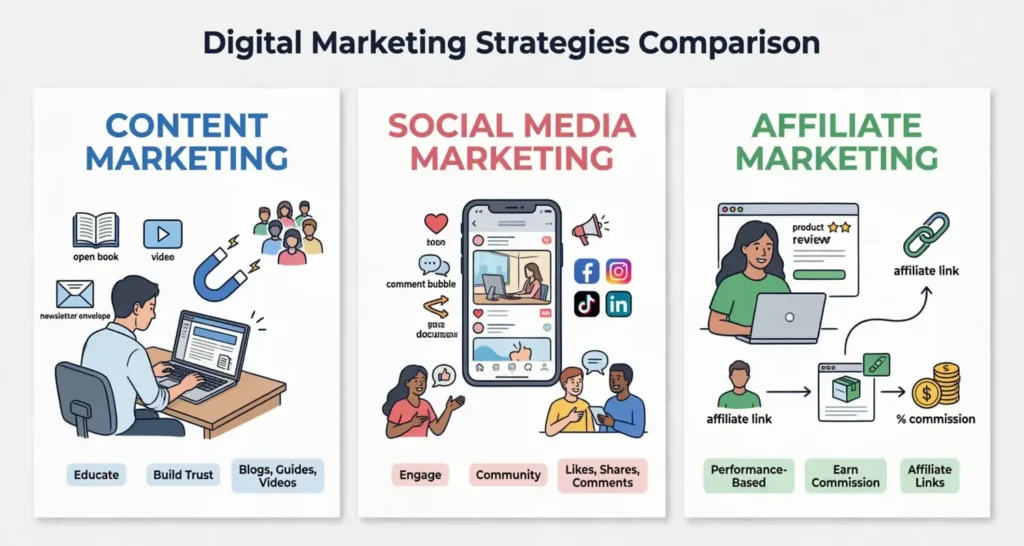
Content Marketing vs. Social Media Marketing vs. Affiliate Marketing
Although these strategies can work together, they have different purposes.
The Future of Content Marketing
The future of content marketing will not simply be about producing more articles, videos, or social media posts. It will be about creating better experiences.
Technology will make content creation faster, but speed alone will not create trust. Businesses will still need strong ideas, expertise, creativity, research, and a deep understanding of their audience.
The strongest brands will likely combine AI efficiency with human originality. The future of content marketing will not simply be about producing more articles, videos, or social media posts. One important content marketing trend in 2027 will be creating better experiences that feel useful, personal, and relevant to the audience.
Use automation for repetitive tasks while reserving human attention for strategy, storytelling, expertise, and decision-making. Audiences do not want to be treated as numbers. They want useful information that helps them solve real problems.
Conclusion
The next stage of digital marketing will reward businesses that combine technology with human value. The strongest organizations will not simply follow every new trend. They will understand their audience, create useful resources, distribute them effectively, and continuously improve based on results.
By adopting these content marketing trends in 2027, businesses can prepare for a digital environment where quality, relevance, originality, personalization, and meaningful audience relationships matter more than simply publishing more content.
Frequently Asked Questions (FAQs)
1. Is content marketing still effective in 2027?
Yes. Content remains an important way for businesses to educate audiences, demonstrate expertise, attract potential customers, and build trust. However, generic content is becoming less effective, so businesses need stronger differentiation and more audience-focused strategies.
2. How will AI affect content creators?
AI can help creators research topics, generate ideas, organize information, analyze data, and speed up repetitive tasks. Human creativity, expertise, judgment, editing, and original experiences will remain important for producing distinctive content.
3. Should small businesses invest in video?
Yes, if the video matches their audience and business goals. Small businesses can start with simple educational videos, tutorials, product demonstrations, customer stories, or short-form content without requiring a large production budget.
4. How can businesses make their content more trustworthy?
Businesses can include original research, real examples, expert opinions, customer experiences, case studies, transparent explanations, and accurate information. Showing genuine expertise is more valuable than simply producing a large amount of content.
5. What should businesses measure?
Businesses should measure metrics that connect to their objectives. These may include organic traffic, engagement, leads, email subscriptions, conversions, sales, and returning visitors. The most important metric depends on the content’s purpose